
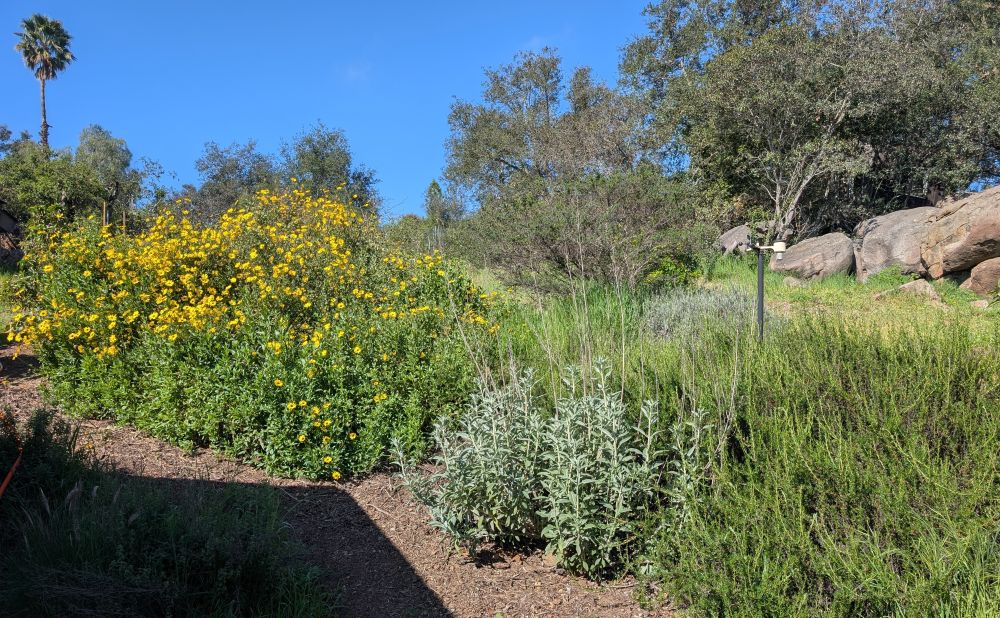
In 2019, I wrote a post about growing a “Bee Garden,” a patch of flowering plants that provides food for bees and other pollinating insects. The point was to bring them in and keep them around such that they would also pollinate my nearby vegetables and fruit trees.
It’s been 7 years. How does my Bee Garden look today? And has it been effective?
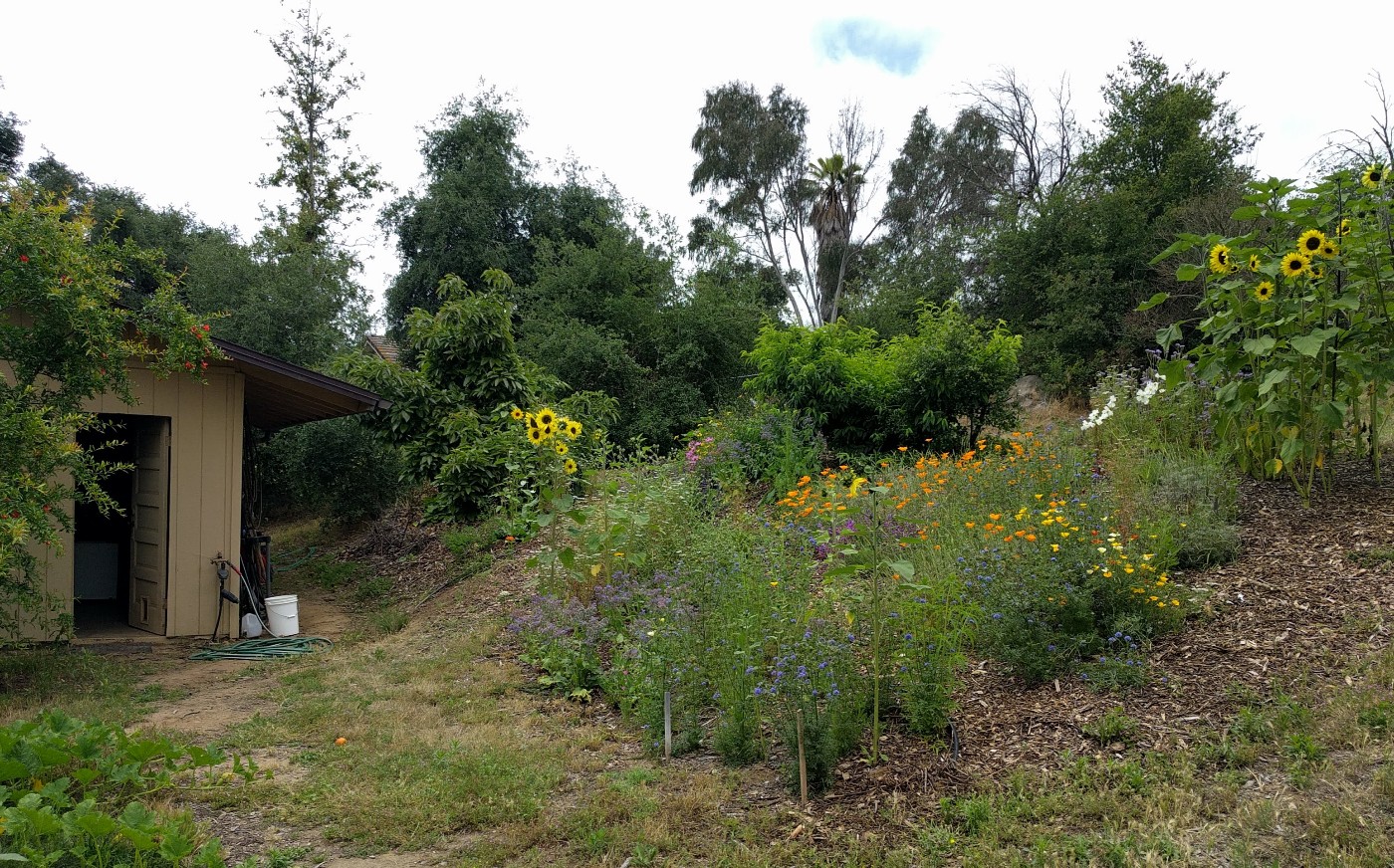

Today, it is less colorful and it has fewer types of plants, I must admit. Initially, I had sown many seeds of annual flowering plants like cosmos, sunflowers, and tansy phacelia. They filled in the spaces between small, new perennial flowering plants. And they provided lots of different shapes and colors. But now the perennials have grown big and filled in all the gaps and I have not continued sowing annual flowers.
Today, the plants that remain are coast sunflower, white sage, oregano, buckwheat, ceanothus, and lavender.
This reduction of diversity was my intention from the outset, actually. I hoped to have the patch filled with more permanent plants that covered the entire area of ground so that no space was wasted and so that few weeds would have room to grow. I didn’t want to allocate too much time throughout the year to sowing new seeds and weeding.
So in a sense, the Bee Garden has succeeded in this respect even though I miss the spectrum of colors that came from the many annual flowers of the first years.
Another of my goals was to have flowers all year long in order to keep pollinators present all year long. I don’t get this, however, not quite. I do get flowers covering most months though.
Coast sunflowers start the year in early winter, then ceanothus in late winter and early spring, then lavender in early spring too. White sage in late spring to early summer, then oregano and buckwheat most of summer and fall.


I do no irrigation. That was another goal I hoped to reach: flowers without irrigation. Committing to that goal has meant that some of the plants get brown and unattractive in late summer and fall.
Has my Bee Garden been effective?
Although it is not possible for me to judge conclusively whether this Bee Garden has increased the pollination of my vegetables and fruit trees, I can say that the nearby fruit trees have had mostly good crops over the past 7 years so it doesn’t seem to have hurt anything.
More than that, I can say for sure that the numbers and diversity of bees and other pollinators that I see in the area are higher than before. Part of that is likely that the Bee Garden provides food for them. Part of that is also likely that I have provided more homes for some of them to raise their babies; I have a few “bee hotels” or “native bee nesting blocks” near the Bee Garden.
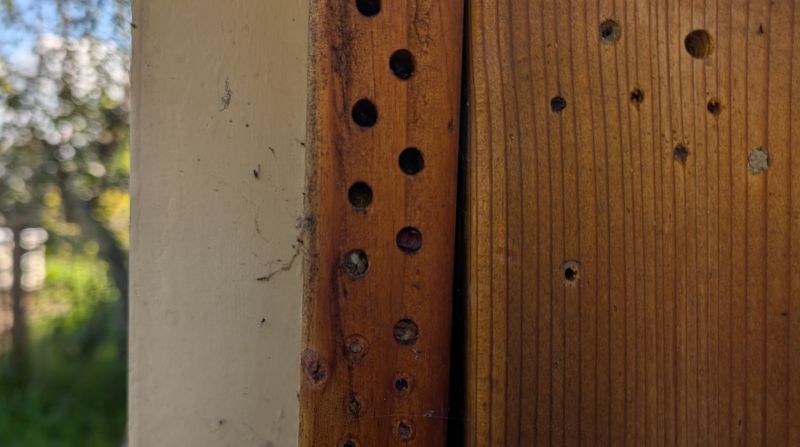
Overall, my Bee Garden is not as pretty as it once was, but it is in a form that I can sustain, and I still love to visit and hover over it to see who is buzzing and zipping around — and zipping over to my nearby avocado flowers as well.
Thank you for your support of my Yard Posts so I can keep them coming and keep them ad-free.
All of my Yard Posts are listed here

Good info, Greg, appreciated. I have 100 fruit trees around my 1/3 acre Houston lot, all citrus in pots, right down to some coffee, guava, starfruit (fruited well last year), cacao, olive. The climate here has changed enough that Houston has gone from peach city, to banana city, to less-ovf-every-fruit city. What cannot be grown to normal size fruit is avocados (heated in the garage with the citrus in winters, and strictly pollinated by 5 types of wasps on my driveway, not bees; but right next to citrus with bees, carpenters and honey.
Keep it up.
Rosemary is a must as it blooms almost all year long. I have rows of it with lavender. Honey bees love them both. For the bumble bees almost anything of yellow color they seem to love. My yellow ice plants the help my slope stay intact from the rains. For the humming birds they love everything red. Hibiscus is one of their favorites. And for so many birds they must have White bird of Paradise for their nectar. Having a diverse ecosystem really does the job. And many of these named plants take next to nothing in water—once established.
Yarrow definitely seems to march to the beat of its own drum. It might be that it’s sensitive to root rot, because it seems to die out when I start it in pots, and none of the ones I’ve planted in my watered garden have gotten established. But it was in a seed mix I spread in my very dry front yard in 2023, and I still find seedlings and established plants from that. The ones I planted on the outside of a tree drip ring do better (maybe because the irrigation is less frequent) and one I bought as a potted plant (I think it was called moonshine or moonlight or something) from Native West got established in a corner that maybe gets watered 5 times a year. I’m also trying out a xeriscape seed mix I grabbed at Home Depot, so it’ll be interesting to see if anything makes it.
Looking good!! Yarrow and blanketflower have also been super drought tolerant for me.
Hi Jessica,
For some reason I’ve had a hard time getting yarrow started, but I do have blanketflowers on the other side of my yard that self sow and are loved by bees.
Yarrow definitely seems to march to the beat of its own drum. It might be that it’s sensitive to root rot, because it seems to die out when I start it in pots, and none of the ones I’ve planted in my watered garden have gotten established. But it was in a seed mix I spread in my very dry front yard in 2023, and I still find seedlings and established plants from that. The ones I planted on the outside of a tree drip ring do better (maybe because the irrigation is less frequent) and one I bought as a potted plant (I think it was called moonshine or moonlight or something) from Native West got established in a corner that maybe gets watered 5 times a year. I’m also trying out a xeriscape seed mix I grabbed at Home Depot, so it’ll be interesting to see if anything makes it.
The gophers eat my yarrow 😆. Otherwise it is a fantastic pollinator magnet!
After some defoliation last year on the old fuerte tree I discovered a sawed off limb than had a bunch of drill holes in it. Too high for me to look inside for bees. Was this intentionally done? It wasn’t me who did it and I’ve lived her for 30 years.
When I moved here, I was surprised that almost always something is flowering here in SoCal (I’m originally from the Netherlands, Seattle like weather). I don’t grow any flowers for that reason but have the “luck” that one of my owl boxes turned into a beehive 3 years ago.
If you are sticking with natives, take a look at Bladderpod. Mine is in the sunniest hottest spot (I live in the inland empire), I don’t water it, and it has yellow flowers almost all year round. And the bees go nuts over it!