
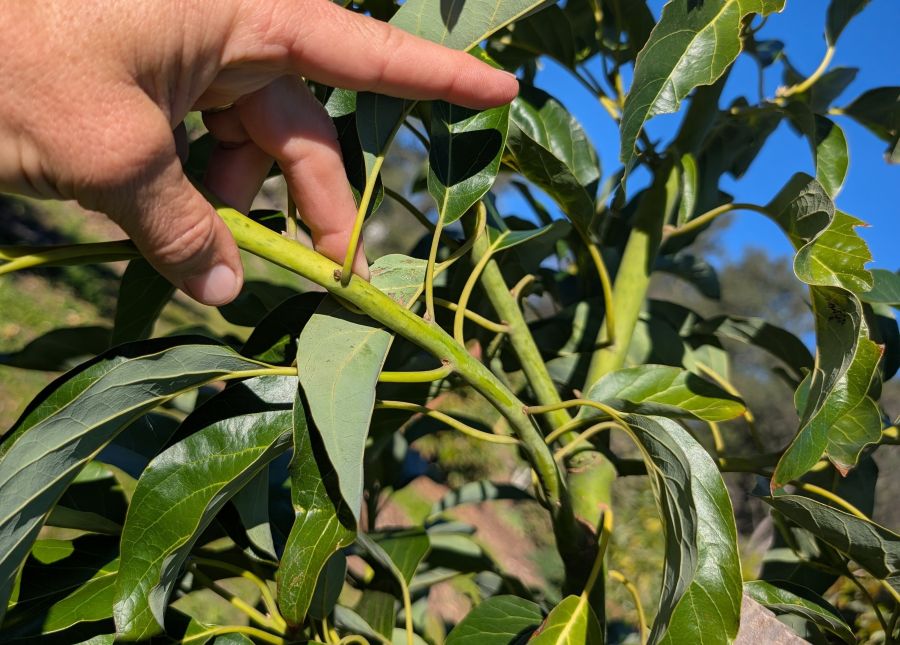
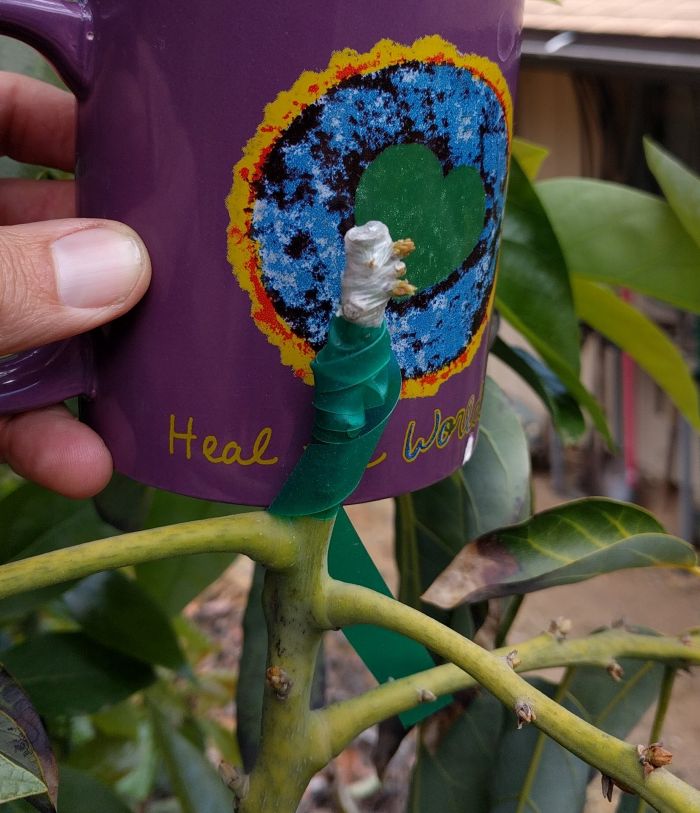
I took a piece of a branch from my neighbor’s XX3/Holiday avocado tree and spliced it onto the top of a little seedling in my yard. This was my first attempt at avocado grafting. And I might have succeeded if I had had this post to guide me in selecting better scion wood.
When to collect avocado scions
Winter, generally speaking, is the best time to collect avocado scion wood.
But before we get deeper, let’s define terms. Scion wood is pieces of branches that are used for grafting. Grafting, in this context, is connecting a branch from one tree to a branch of another tree such that they grow together. The bottom part that is connected to the roots is called the rootstock, and the top part that will hopefully, eventually, make fruit is called the scion.
December and January are almost always good months in which to collect scions for avocado grafting. February often is too. And sometimes March remains a good time.
It depends on the weather and the activity of the tree.
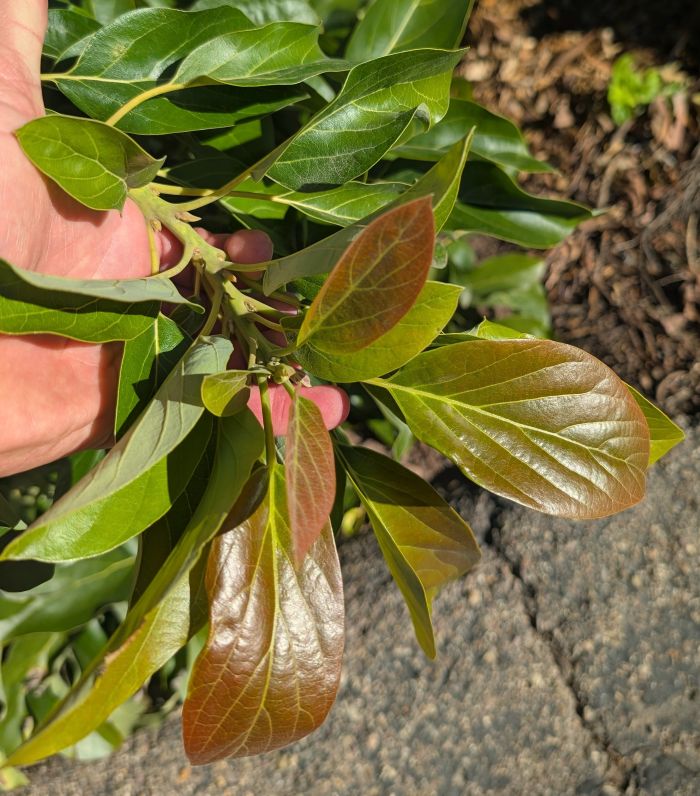
Winter is a good time because avocado trees are usually inactive; they are not flowering or growing new leaves. In winter, you can take a piece of a branch from an avocado tree that is full of latent energy. It is ready and able to grow but is not currently growing.
A couple of side notes:
One, around July and August is another period where good scions can often be found on an avocado tree because the branches that grew in spring have paused and “hardened off” such that they are similarly filled with latent energy.
But summer scions are not quite as good as winter scions. They often have to be older and thicker because the thinner branches in summer are too flimsy (pithy inside) and actively growing.
Two, it’s best to cut scions during non-stressful weather and non-stressful times of the day, regardless of the season. This means that you should not cut during Santa Ana conditions, if possible. Also, try to cut in the morning because the tree will have had all night to become full of water and the scions will therefore desiccate more slowly.
What scions to collect
Buds on scion
The parts of the scion that will grow are the buds. This is why an avocado scion is also called budwood. The buds are located just above where each leaf attaches to the branch (the “axil”).
Buds that are good to use for grafting are relatively large and plump.
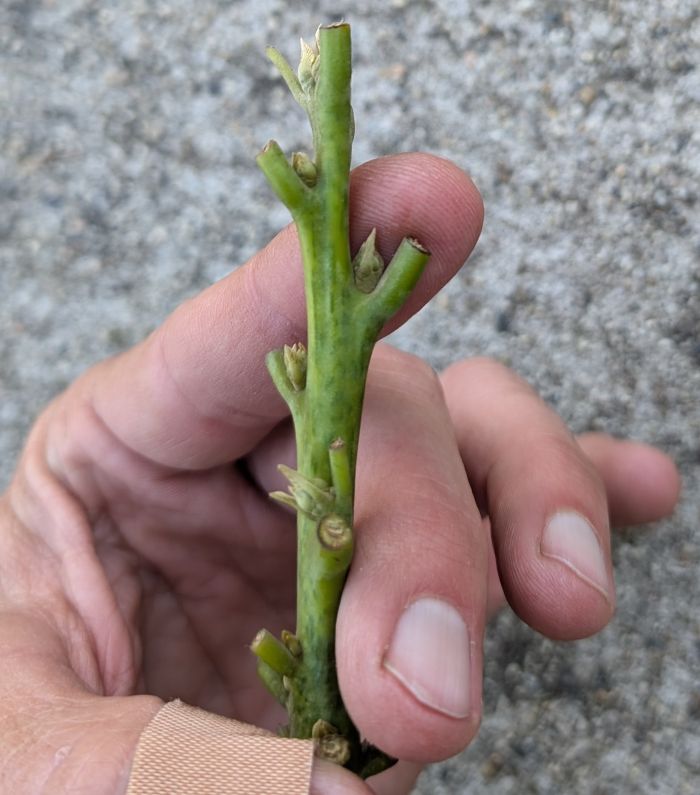
However, varieties differ in the look of their buds, which is why I said, “relatively large and plump.” The buds on branches of the Gwen variety, for instance, are generally smaller than those on Hass.
Good buds can be located anywhere along a branch. They are usually toward the end, but not always at the very end. If the best buds are located back from the end, you can just cut off the undesirable end of the branch.
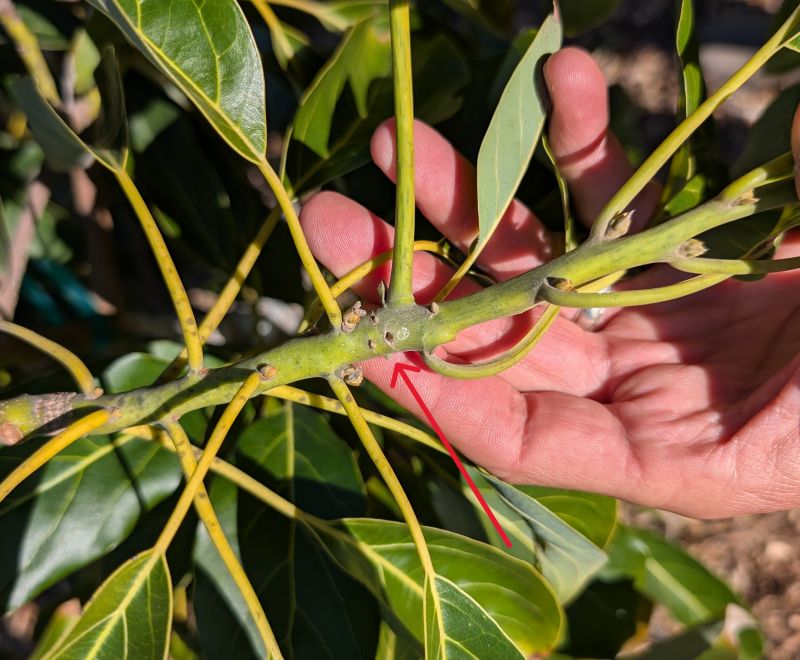
Lastly with regard to avocado buds, there is the whorl or knuckle. This is a ring of multiple, small buds around an avocado branch. It can be found a few inches from the end of the branch up to many feet from the end. This whorl or knuckle of buds can be used successfully for grafting too.
Gray Martin made a video some years back on “Selecting avocado budwood” that is worth watching. Martin has many years of grafting avocados professionally under his belt. I have gained many insights into avocado grafting from him.
Size of scion
How long and thick should the avocado scion be? That depends on what you’re grafting it to.
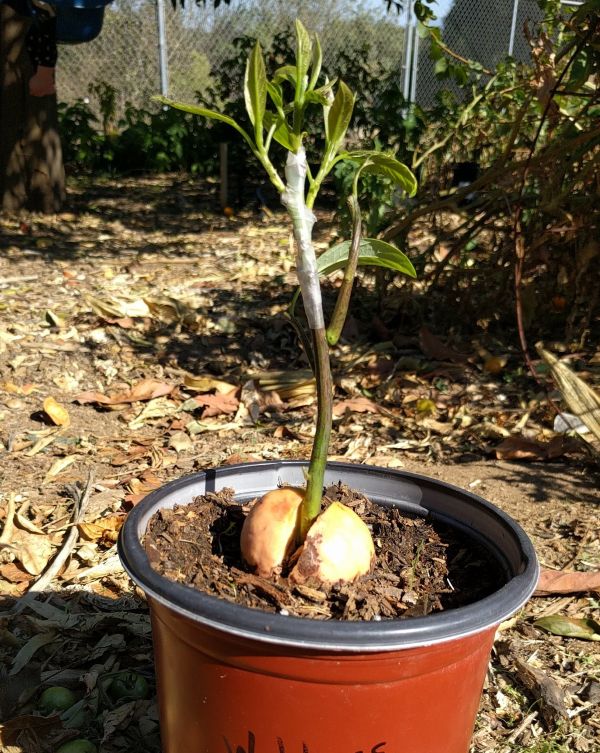
Ideally, you want the diameter of the scion to be the same as the rootstock if you’re grafting onto a young seedling tree and using a cleft or splice graft. But if this isn’t possible, you should try to get the diameters close.
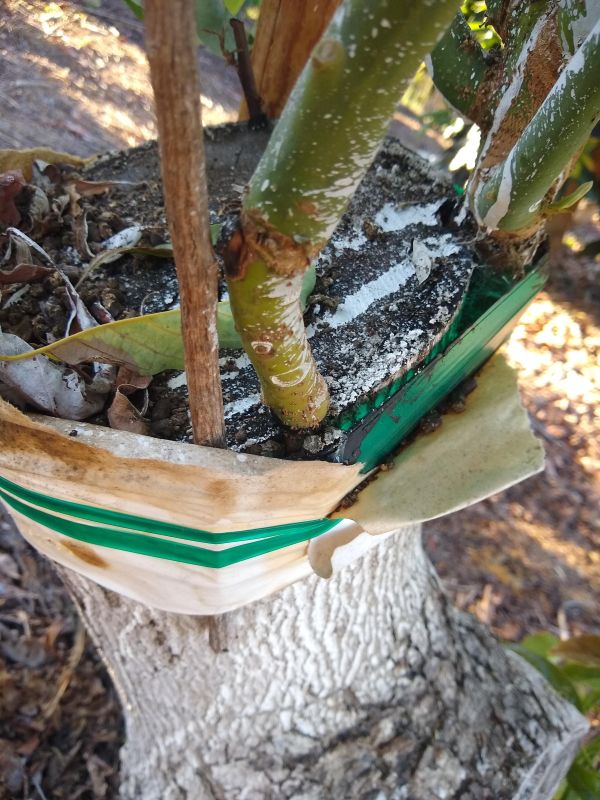
For grafts onto larger stock (such as branches on an already planted tree or stump), you want a scion that is larger and stiffer (older, more yellow than green usually).
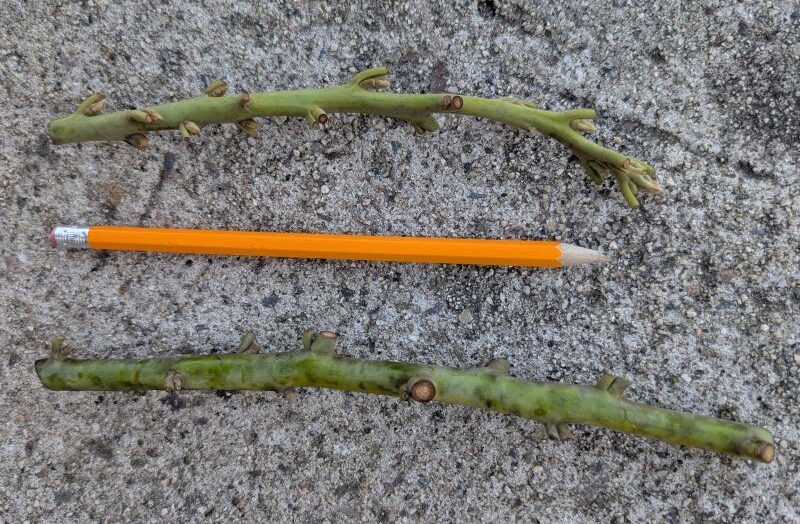
As for the length of the scion, this also varies similarly according to the stock it is to be grafted onto. That is, the larger stock usually requires a longer scion.
Strictly speaking, the scion only needs one good bud plus enough length below that bud for a cut that will be connected to the stock. But it’s usually best to have two or three good buds on a scion, if possible. And it’s best to have a straight section without too many leaf stubs below those buds where you can make a cut of about three inches long.
Overall, good avocado scions are usually about five inches long for small stocks and about 8 inches long for large stocks. It’s smart to cut them longer initially so that just before grafting you can cut off and discard the ends that have dried out.
I should also note that in a study done by Rodrigues, Ryan, and Frolich that was reported in the 1960 yearbook of the California Avocado Society it was found that graft success rates were twice as high with longer scions compared to shorter scions. Specifically, 6-inch scions had far better success compared to 3-inch scions, especially when grafted in the summer.
Avocado scions to avoid
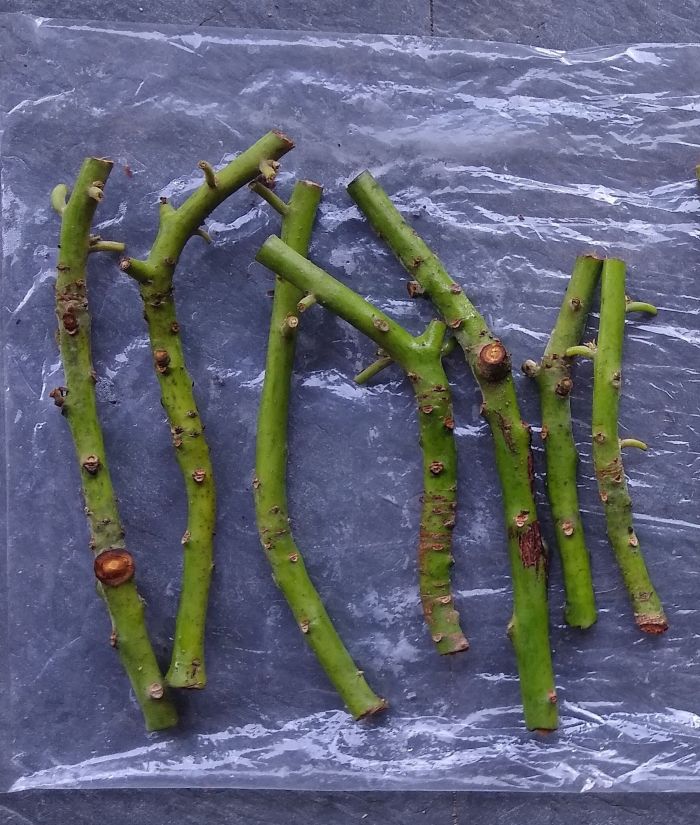
If possible, avoid cutting or taking (from a friend or a scion exchange) avocado scions that look like these because they are less likely to be grafted successfully:
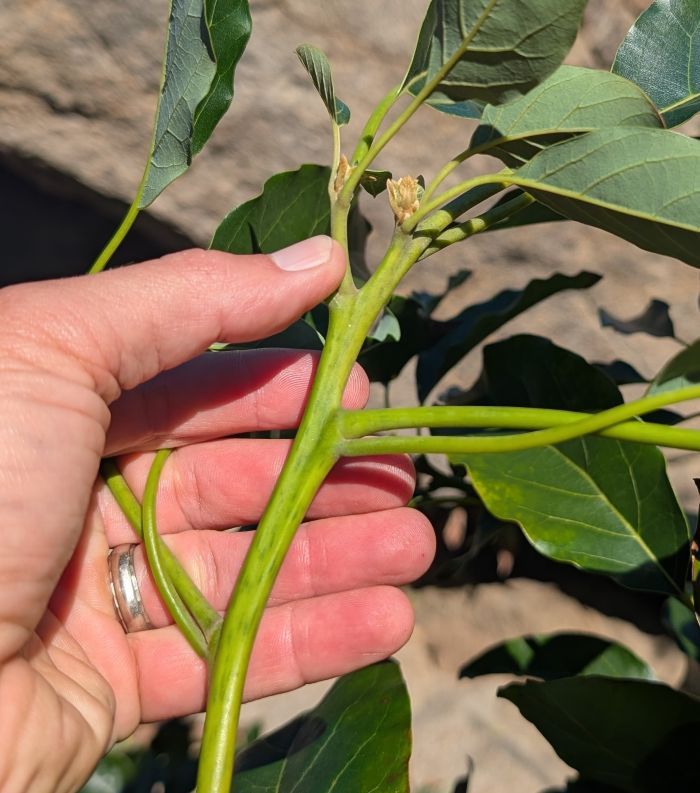
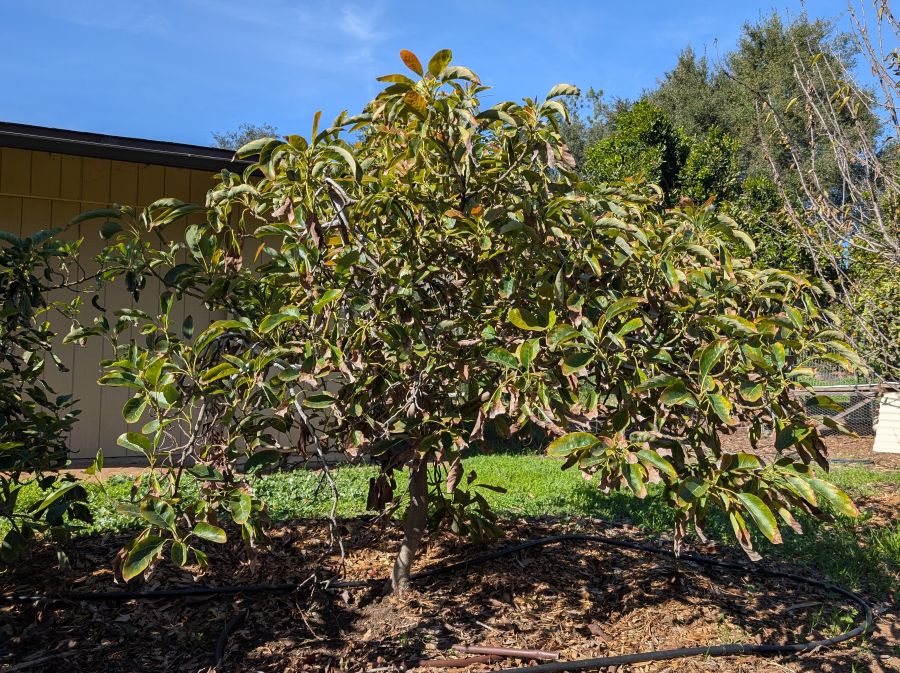
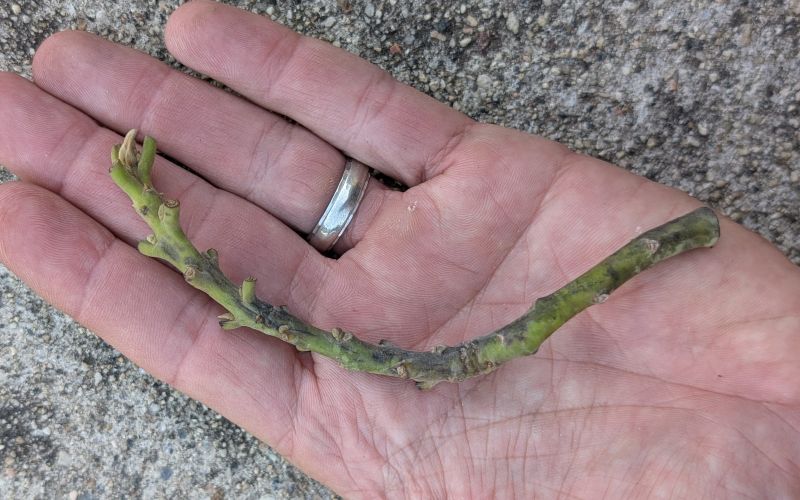
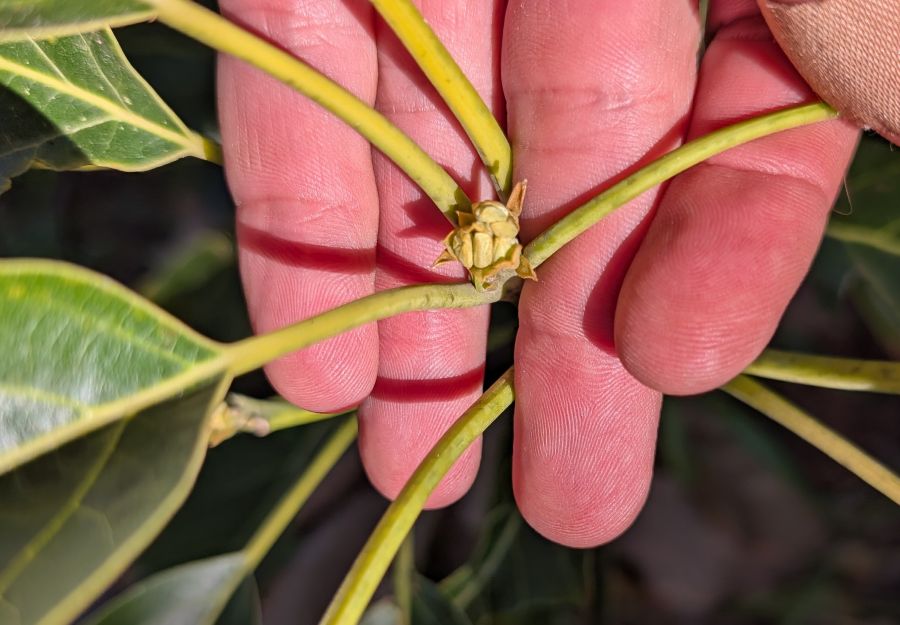
If you have many trees or many branches from which you can get avocado scions, then take this further advice: “Cut grafting wood [only] from branches that have demonstrated high production of true-to-type fruit, on healthy, vigorously growing trees.”
This comes from the excellent booklet, “Propagating Avocados,” published by the University of California. It can be viewed here or here.
Remove leaves
Immediately upon cutting a branch off to be used as a scion, remove all of the leaves. Cut the leaf stems off or snap them off, it doesn’t matter which way you do it.
The leaves must be removed because they will suck water from the stick and dry it out.
How to store avocado scions
From the time of cutting or the time of collecting (from a friend or a scion exchange), you want to keep the scions in shade, cool, and protected from drying out.
If I am doing the cutting, I put the scions into a plastic bag that is kept in shade and then placed into a cooler or fridge as soon as possible.
If I am attending a scion exchange, then I bring my own plastic bags and cooler to place my scions in as soon as I select them.
Plastic bags that are thin like grocery store produce bags work fine. Roll the bag up in order to make at least a partial seal; remember that the point of the bag is to prevent the scions’ dessication.
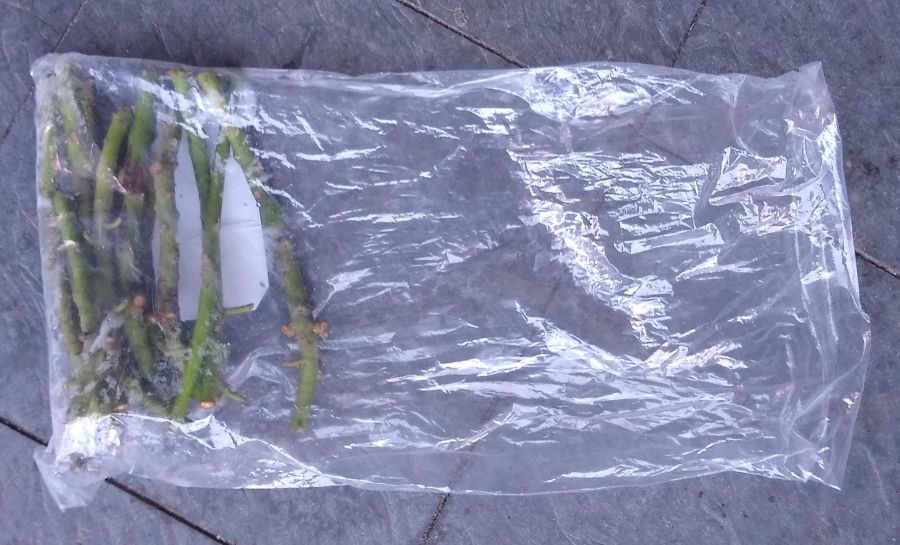
Thicker plastic bags also work fine. You do not need to totally seal-lock the bags, but you ought to roll or partially seal the bags.
You also don’t need to add a wet paper towel or other item to add moisture although it is acceptable to do so.
As soon as practical, get the scions into a refrigerator. The coolness of the fridge slows the decay of the scions.
But watch out for too much moisture in the bags and on the scions if they are stored for long. If you see condensation in the plastic bag or if the scions are wrapped in a wet paper towel, you should periodically pull them out to see that there is not free water on the sticks. Too much moisture will rot them.
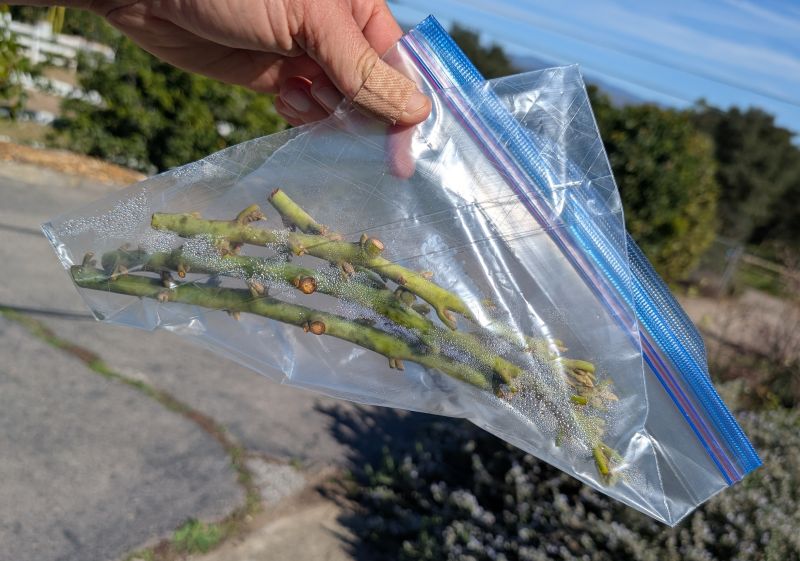
How long can you store avocado scions?
A properly cut and stored avocado scion will remain viable for at least a month in the fridge.
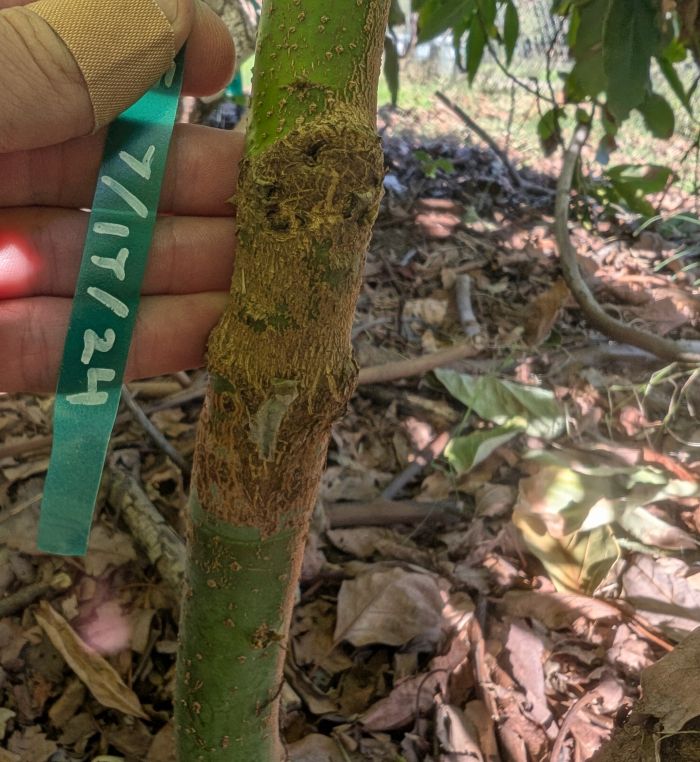
A couple years ago, I harvested scions on March 22 and kept them in the fridge for almost four months until grafting. I did two grafts with these March-cut scions on July 17, 2024, and both took.
Again, the topic of avocado scion storage was studied and reported on by Rodrigues, Ryan, and Frolich, and they found that “scion wood cut in late winter or early spring can be stored successfully at 40° F . . . for at least three months.”
This is not to say that you should wait three or four months to use your scions but just to comfort you and assure you that avocado scions cut at the right time and stored in the right way can remain viable for many weeks until you are ready to graft them. So don’t feel rushed as you find the right stock to graft onto. Best of luck!
You might also be interested in these posts:
“Where to get avocado scion wood”
I write these posts for you and I do not allow advertisements to clog them up. Consider becoming a Yard Posts Supporter so I can keep them coming and keep them ad-free. Thank you.
All of my Yard Posts are listed here


Appreciate you speaking at the EcoFarm conference on Avocados last week. I live in Chino and have followed your very HELPFUL blog for several years. I Love seeing photos of your children as they grow. I was going to personally say hello, but you three speakers were very popular. It was great to finally connect. Blessings,
Hi Pam,
Wish you had introduced yourself. Thanks for the kind words. That was a busy couple hours, trying to cover “all about avocados.”
Perfect timing on this post! Im planning to harvest some scion wood from my “cuke” Fuerte for this weekend’s NSD CRFG scion exchange.