
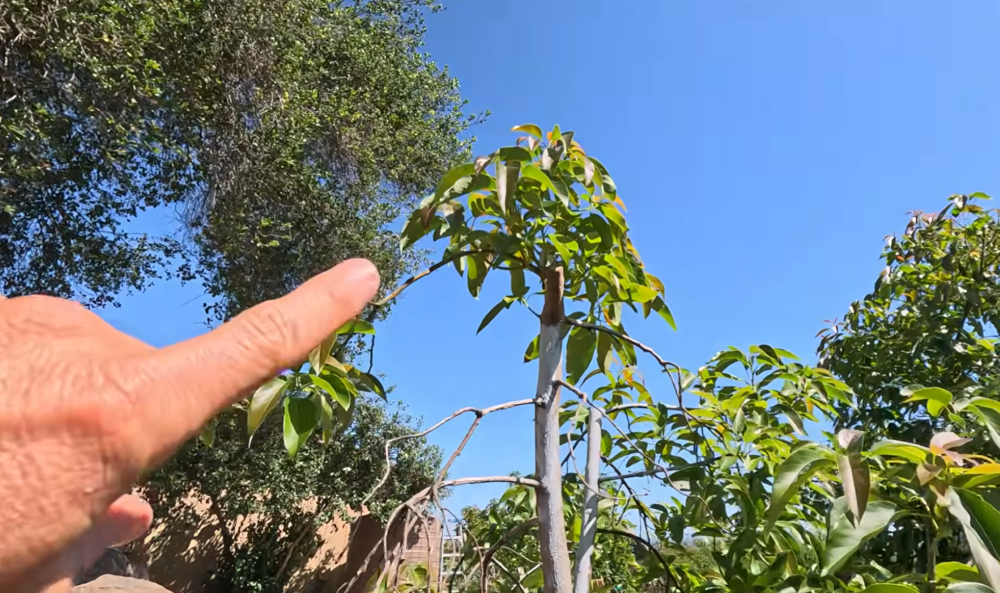
May is usually an easy time of year for an avocado tree in Southern California. Therefore, signs of ill health now should be taken seriously and, if possible, remedied before the potential stress of heat or drought during summer arrives.
In my yard this May I have some healthy and some not -so-healthy avocado trees. I walked around with my video camera showing examples of each and explaining the five signs that I look for when assessing avocado tree health.
Join me:
Again, these are the questions I ask myself when I look at a tree:
1. How long do the old leaves hang? (The longer, the better.)
2. Are the peripheral branches green? (Yellow or gray or brown is not good.)
3. How long are the new shoots? (The longer, the better.)
4. How healthy is the top of the canopy? (Dense is good; sparse is bad.)
5. How big do the new leaves get? (The bigger, the better.)
I think that an important take-away is that a tree’s overall health is primarily determined by the health of its root system.
We only look for signs in the canopy because we can’t easily see the root system.
But when we look to improve a tree’s health, we should mostly think about what’s happening underground. Think about competition from nearby plants, improper watering, infertile soil, shallow soil, bad rootstock, and improper planting.
Here is a related post:
My Yard Posts are powered by you. I take no sponsors and run no ads. Thank you for your support!
All of my Yard Posts are listed here

Boy was this helpful to identify what is healthy and what is not…
So how do you address the sick trees?
I have super slow growth on 3 yr old trees…
And I thought they were doing ok considering the erratic weather.
They are definitely not thriving but I was happy they didn’t die.
Heat wave, followed by cold snap, heat wave followed by hail and recently high winds and rain.
It’s been rough on my Lula & Mexicola but my Zutano took everything like a champ.
Very helpful! Wasn’t aware of several indicators.
Thank you for this post. I became more aware of what to pay attention to.
Ugh your sick trees are happier than what I thought were my healthy trees lol.
No way! I don’t believe it, Brandon. Well, maybe I do. I have had sicker trees too.
I hope yours are on the rebound and next year they’re hitting all the right marks.
Greg,
Thank you for speaking at the recent CRFG meeting.
I asked the question about growing fruiting avocados in containers.
I appreciate the information and references you shared and the encouragement that it is at least possible.
I live southwest of the meeting and don’t want or need hundreds of fruit – a few handfuls each season are more than enough.
After buying (and failing) many avocados over the years, I am ready to try again with the guidance you provided and past Yard Posts (which I have been reading for years).
My plan is to get 2 or 3 varieties – GEM, Gwen and Little Cado for A and B flowers in (up to) 25-gallon nursery pots.
Is thar a good mix of varieties or do you recommend something different?
Thanks
The two weeks heat wave was rough on the trees. One of my avocados dropped all her leaves. But lucky she had new ones ready and waiting to grow. Quickly you must assess the situation. New compost, mulch, steer manure to keep the base cool. Water is a must as avocados drink even more as our temperatures rise. So far out of my twelve trees we only lost the Zutano fruit. Everyone else is holding on. Every tree will behave differently. Genetics is the reason why. Some trees will drop leaves, other will give up their fruit. We always have to stay on top and read our trees. They are like children they take a lot of care and observation.
Thank you for sharing this information. Very helpful in understanding what to look for. We have a very young tree that we planted over a year ago that I think has gone through some shock but has shown some growth, so I’m hopeful. I’d like to share the images of the current state with you. I will send to your shortly.
Thank you for such a thorough and timely video . . . so informative. Really helped me to understand our 80 year old backyard (Fuerte) avocado tree better . . . it is huge and carries examples of all the issues you demonstrated, good and bad . . . including parts that look incredibly healthy, but some dry branches up top that we cannot trim on our own. Dry crisped leaves amid tons of new growth with large green leaves or the new red ones. Flowers heavily, but fruit crop varies from year to year. This tree is also sharing resources with neighbors’ mock orange and a magnolia. And yet it is strong and steady year after year. I pay attention to its growth cycles, do a weekly soak when the heat arrives and extra when we get these awful heat waves. I feel like that’s all it wants.
Hi Cindy,
Old trees like your Fuerte are in a category of their own. They are very tough (for an avocado) so you can mistreat them for a while and they will still appear to tolerate it.
Lack of sufficient water: they might just drop some fruit. Digging or compacting the dirt under the canopy (such as when building a patio): they might show only a little dieback in upper branches.
It’s deceptive because you think you can get away with such mistreatment. But the decline is only delayed and more gradual. Once it starts to show with clear symptoms in the canopy it is sometimes impossible to stop.
I’ve tried to help homeowners revive old Fuertes (they’re always Fuertes) that are sick, but usually we fail. I hate that.
It’s good to hear that you are caring for your old Fuerte attentively. I hope it lasts another 80 years.
So true it took me nine years to get back an old Fuerte it’s around thirty and came with the house lots of amendments minerals and fertilizer and of course water
Me, too, Greg – thanks for all that! We do keep an eye on it for significant or troubling changes . . . will probably have a tree trimmer out to clear the dead branches near the top in late fall. It’s been more than 10 years since we had it trimmed, mostly because the last time we did (in a January month) the tree did not produce fruit for several years. Thought maybe we had inadvertently interrupted an important developmental cycle. So our giant avocado sits in the heart of old Glendale suburbia, up against the Verdugo foothills, and was part of a large grove before the land was subdivided and a streetful of late 1920’s-30’s houses built, like ours. Might be even older than we think haha.
Hi Cindy, I have an 30+ year old large Zutano tree in my backyard in National City. I also had a pro come out and they gave it a big January trim several years ago, and we didn’t get any fruit for about 2 years. Even though that was disappointing, it has really responded well and this spring the tree is finally back in full force with hundreds of little avocados!
My Hass tree loses all its leaves every fall/winter and grows new ones in the spring. All other symptoms are OK, and production is good. It is suffering from heavy infestation of Persea mite that is hard to stop. My Fuerte and Lamb pass all the tests and keep old leaves.
Hi Greg, Thanks for the wealth of info I enjoy your content.
I have a tree health question about lazy Lambs and Reeds. Leaf/color/growth at top all look good (and It may have been the second year trimming or lack thereof) but I have tons of long spaghetti limbs running towards the ground around the trunk (many with very large fruit) over the bottom half of some of the trees. I left most last year to help cover the fruit which only made things worse now as tree size has doubled. I am removing now as I feel like I don’t have any other option.
If I am aggressive in removing the the spaghetti to promote healthier growth it denudes the bottom of the tree in many cases. I will admit there’s not many more left to trim, and I wish I had asked this question a week ago, but is there some other option for the few I have remaining?
Also, some of these lazy trees still require staking (still staking/tying on year 3 going against your advice) to keep the tops from falling over and growing towards the ground (or off toward the neighbor). Should I just top these (regardless of height?) and not stake/tie?
While I do have a few “not so great” trees most of the positive indicators you described are present for me with the above noted issues. I am however VERY confused, not at your info but at the state of being of my trees vs yours. As of this writing, it looks like you still have flower (which was done for me 2 months or more ago) and I have tons of golf ball (and smaller) fruit set already.
You also made a comment in another post about eating your last Lamb in February, and I still have dozens with no signs of black at all (although I have (and am) harvesting a ton already).
I am in Jamul just to the south of you at 2300 feet, obviously a different micro climate but that different?? It seems as if we have completely different growth/flower/fruit timing?
Thanks
Sam
Hi Sam,
It was nice to meet you last week. I tend to have later flowering than everyone else so it’s not surprising to hear that your trees are more advanced than mine.
You might find that a couple of Lambs on your trees are turning black now (from flowers that set fruit last spring, the spring of 2025), but probably most are still green. I like to pick Lambs according to color, and leave the green ones on the tree. This way you can spread out the harvest as much as possible, and you ensure that you’re picking only the most mature avocados.
There’s no easy answer to the staking/trimming issue. Good trees can be grown with stakes on them forever, even past when the tree is holding up the stake instead of vice versa. I’ve seen many farms where this is the case because they just don’t want to spend the money on labor to manage this, and the trees still perform acceptably although not ideally.
Likewise, I’ve seen good young trees grown with lots of low “spaghetti” branches and good young trees grown with all branches below a couple feet removed. We just have to consider the tradeoffs.
I don’t like to prune up too many low branches on young trees because I’m in a hot location where I have to protect trunks from sunburn if there are no branches and leaves to do so. The irrigation water is also more vulnerable to evaportation.
However, pruning up lower branches means that the tree puts its energy into growing the upper branches, which is a good thing for a young tree that is still short.
I have some new trees from a nursery where all of the lower branches were cut off before I received the trees. They’re growing well, but I have had to wrap the trunks in shade cloth and put extra mulch under them to mitigate evaporation and heating up of the dirt below these trees.
I have some other new trees with branches down low and they’re also growing well, but I have to pinch back the lower branches to make sure that they don’t do most of the growing at the expense of the upper branches. This takes time. But I like having the trunks and irrigated area under trees naturally shaded by those branches. In a year or two, I’ll entirely remove the branches below about knee height.
Greg,
I lost count of how many times I’ve watched and rewatched your videos on YouTube! Thank you for being an amazing resource.
I looked for an active avocado online forum, but couldn’t find one, so I’ll ask here and perhaps you or someone can point me in the right direction. About a month and a half ago, I bought a 15g Hass and 15g Reed from a nursery up here in Ventura County. The Hass was flowering when I bought/planted it, but I still didn’t expect any fruit. However, I was hopeful for next year soon after when I counted about 20 little pea-sized avocados emerging on various parts of the tree. Fast forward a few weeks, and I’m down to 6, two about the size of a fat peanut. I saw a few that were still on the tree that looked like they had a divot in them. Not sure if it was from some sort of rot or a bird. Both trees have metal mesh around them, so I don’t think it’s from a creature. Some of the leaves are pretty jagged and look like they may have been eaten. The leaves are a light green (much lighter than compared to (Andy) Reed, but I have yet to see a dead one nor see any on the top of my leaf mulch below, and there is new leaf growth emerging from several branches including the top of the tree. Any thoughts or recommendations, including an online board?
Hi Michael,
Your trees sound like they’re doing okay. June bugs munch on avocado leaves this time of year, as do grasshoppers and a few others. See here: https://gregalder.com/yardposts/who-is-eating-holes-in-your-avocado-leaves/
It’s normal for a tree to drop much of the tiny fruit that starts to grow. On a recently planted 15-gallon tree, you should only expect or even desire a couple of avocados to remain to maturity.
I know there are a few groups on Facebook dedicated to avocados in California or Southern California. And people talk avocados within the Tropical Fruit Discussion of the Tropical Fruit Forum: https://www.tropicalfruitforum.com/index.php?board=1.0
Hi Greg, I have a 2 year old avocado tree (I think it’s a sharwil) and the lower leaves are doing 2 things. Weird colorations but the new growth is coming in healthy at several places. Should I be concerned? I’ve attached some pictures. Thanks! https://ibb.co/x8z1y4Xk
https://ibb.co/nsN59GBN
https://ibb.co/gC0Kc3s