
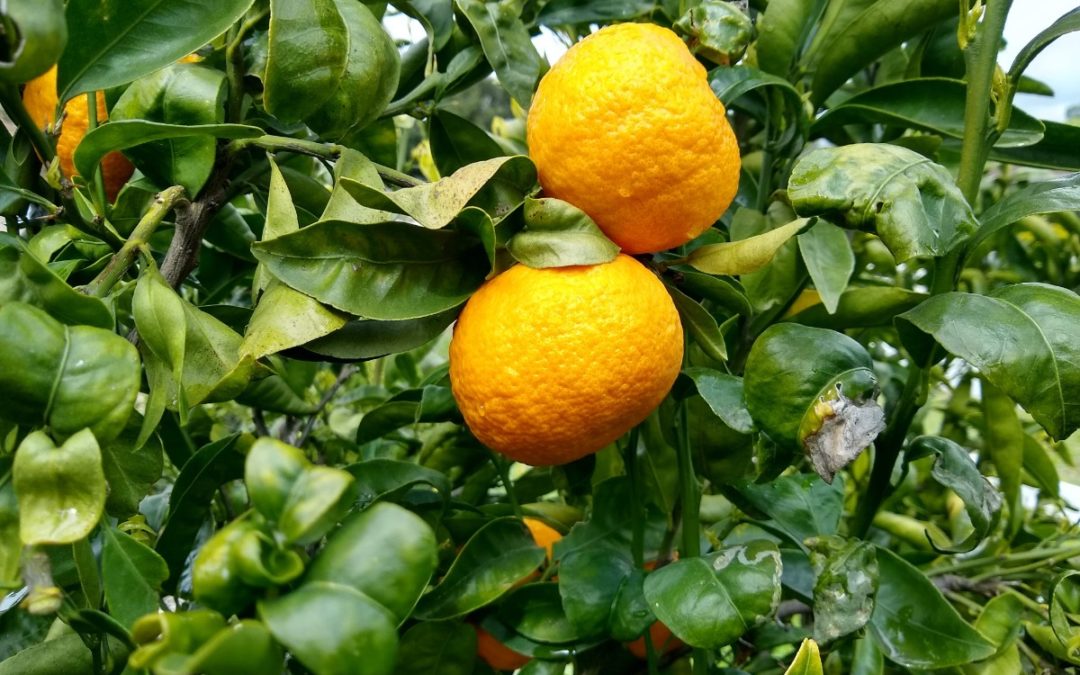
“If I only had one citrus tree to live on for my entire life, this is it,” said our guide through the collection of about 1,000 varieties of citrus selected from around the world. That’s quite a claim. But, coming from Ottillia “Toots” Bier, we would be wise to consider it. She has tasted the fruit of hundreds of citrus trees; I’d guess she has experience with as many types of citrus as anyone on the planet.
We were at a Gold Nugget mandarin tree in the Citrus Variety Collection at the University of California, Riverside. This was the middle of March, 2012. This was my first time tasting a Gold Nugget mandarin.
I was sufficiently impressed to plant my own.
Let me tell you more about the fruit and the tree of this variety of mandarin called Gold Nugget in order to help you decide if it is worth planting in your yard.
The Fruit
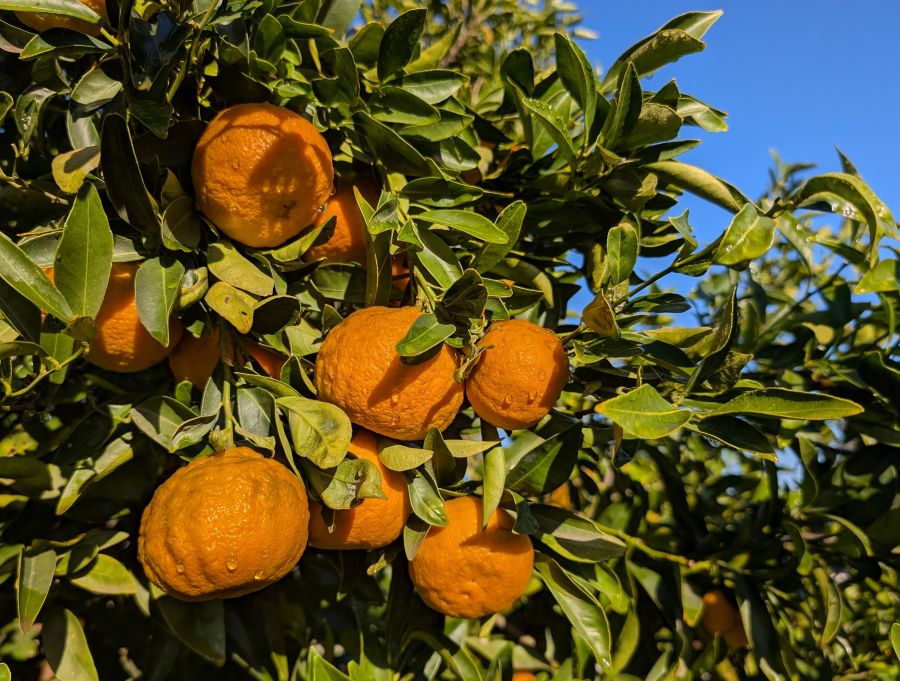
Compared to other mandarins, Gold Nuggets are medium size — bigger than Kishu or Tango, smaller than Shasta Gold or Shiranui. The name Gold Nugget comes from the appearance of the fruit’s rind, which is bumpy and ribbed. Unlike some other mandarins, Gold Nuggets do not have a nipple at the stem end where the fruit attaches to the tree.
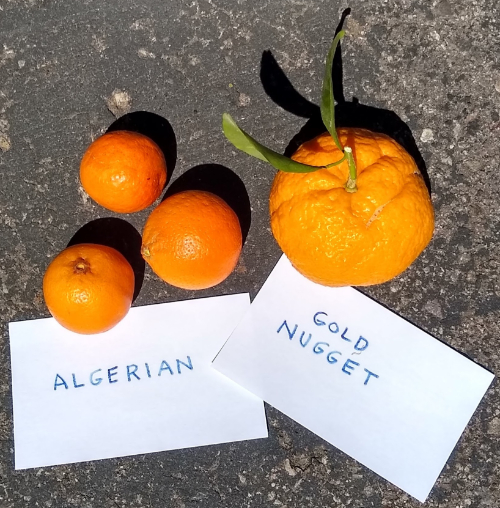
Once Gold Nuggets are mature, you can easily peel them with a single corkscrew motion, popping the pith at the core out of the bottom.
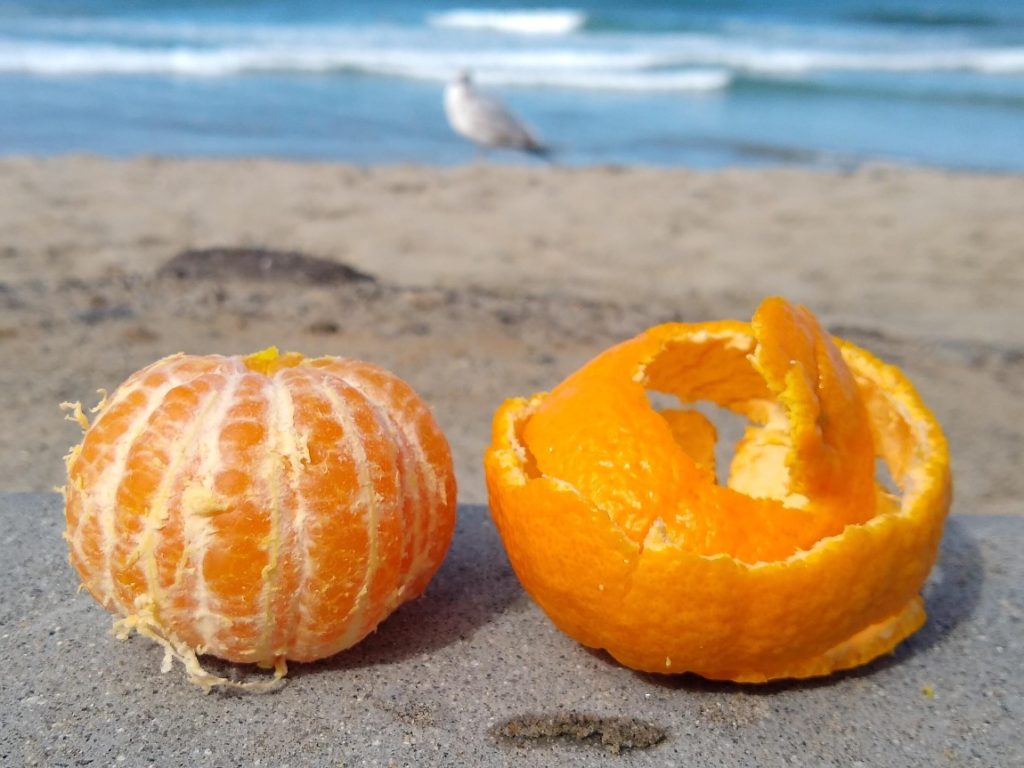
You would find Kishu or Satsuma mandarins even easier to peel than Gold Nuggets, but Gold Nuggets peel easily enough that my two-year-old daughter doesn’t ask me for help.
As you peel, Gold Nuggets release heaps of aroma and oil from the rind. It’s an intoxicating smell, but it does make your hands messier than with some other mandarins whose peels come off more dryly.
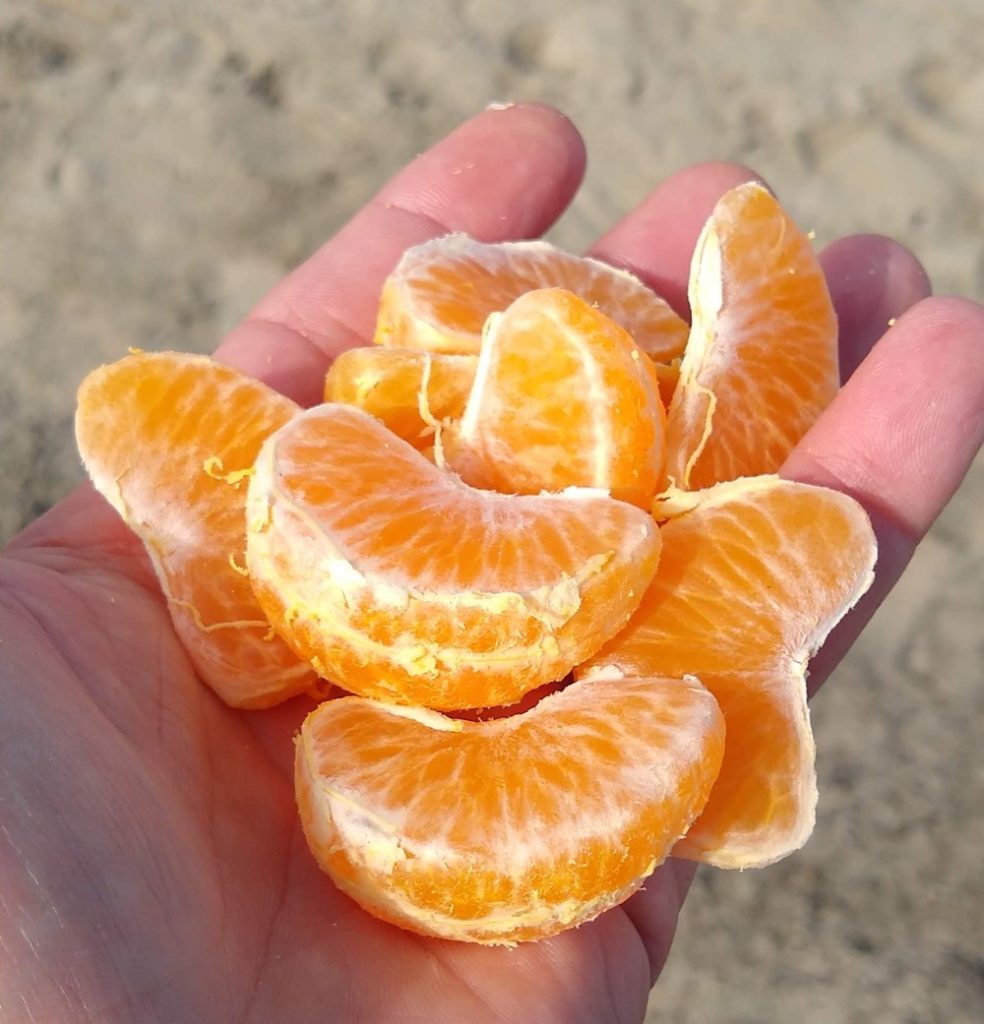
The segments of Gold Nuggets are easily separated, seedless and firm, bursting with juice. The flavor is rich but mostly sweet; it does not have the tang associated with some other mandarins such as Dancy.
The Tree
Vigorous is the word that comes to mind when I think of a Gold Nugget tree. Mine was planted at the same time as some of my other citrus trees and it is on the same rootstock and yet it has grown a bit faster.
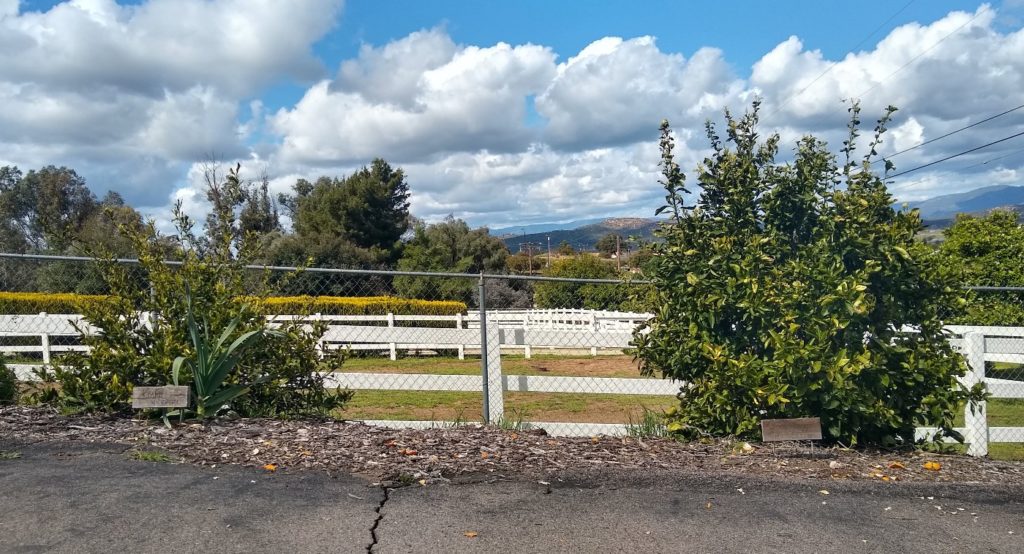
This might be in part due to the fact that its fruiting has alternated somewhat. For example, in 2020 we ate a few hundred Gold Nugget mandarins from the five-year-old, five-foot-tall tree, but in 2019 it produced only three, three lonely pieces of fruit. The year prior, it had an abundance of fruit. Here it was in that year, 2018, three years after planting from a five-gallon container:
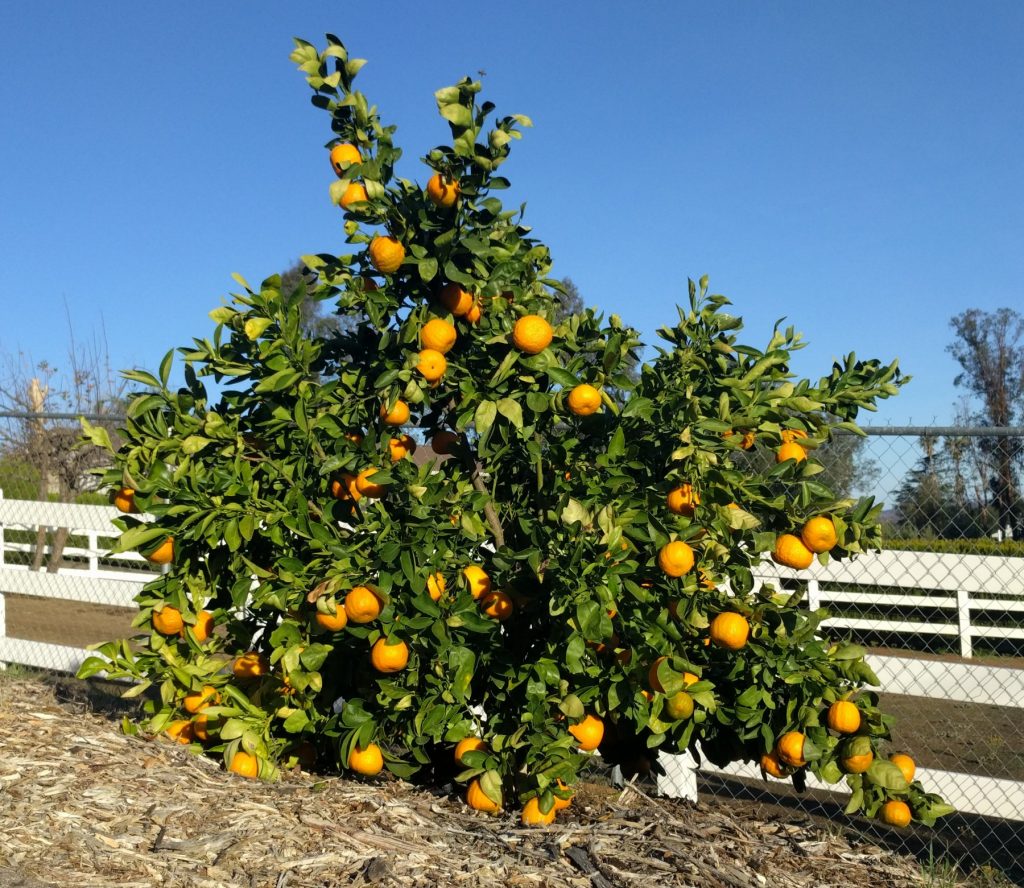
Farmers don’t like that Gold Nugget trees tend to alternate bear, and I imagine some home growers wouldn’t like this either. I don’t mind because I have other mandarin trees whose harvest season is at about the same time, such as Pixie. But if you are looking for a mandarin that produces fruit more evenly through the years, then Gold Nugget might not be your best bet.
However, I have found in more recent years that my Gold Nugget tree fruits more consistently, and I think this is because I have been pruning it for size control, which inevitably removes part of the crop each year.
It is also said by others that the alternate bearing of Gold Nugget can be moderated through pruning.
Variety development
We call Gold Nugget a mandarin, but technically it is a mandarin hybrid, as it has some orange in its lineage. In the 1950s, citrus breeders at University of California, Riverside crossed the Wilking mandarin with the Kincy mandarin, and both of those mandarins are actually mandarin hybrids. Wilking and Kincy both have King tangor as a parent, a tangor being a cross between a mandarin (tangerine) and an orange.
(Read more about Gold Nugget’s development here and here.)
Harvest season
Here in March is only the beginning of the Gold Nugget harvest season. We are in inland San Diego County, and our Gold Nuggets start to taste good and peel well from March. (This is late compared to most other mandarin varieties, some of which mature as early as November.) Gold Nuggets will continue to sweeten and peel even more easily through spring and into summer.
For how long can Gold Nuggets hang on the tree and maintain quality? I’ve eaten some from a tree in Valley Center in San Diego County in September that were still very good. Toots said that she has picked fruit from her own tree in her Huntington Beach yard in October that was still “sound and good.” That Gold Nuggets store so well on the tree was a major reason that Toots called it her number one citrus (the other major reason being its outstanding flavor).
From my own tree, the latest I’ve had good ones is the end of August, but they taste their best around May and June.
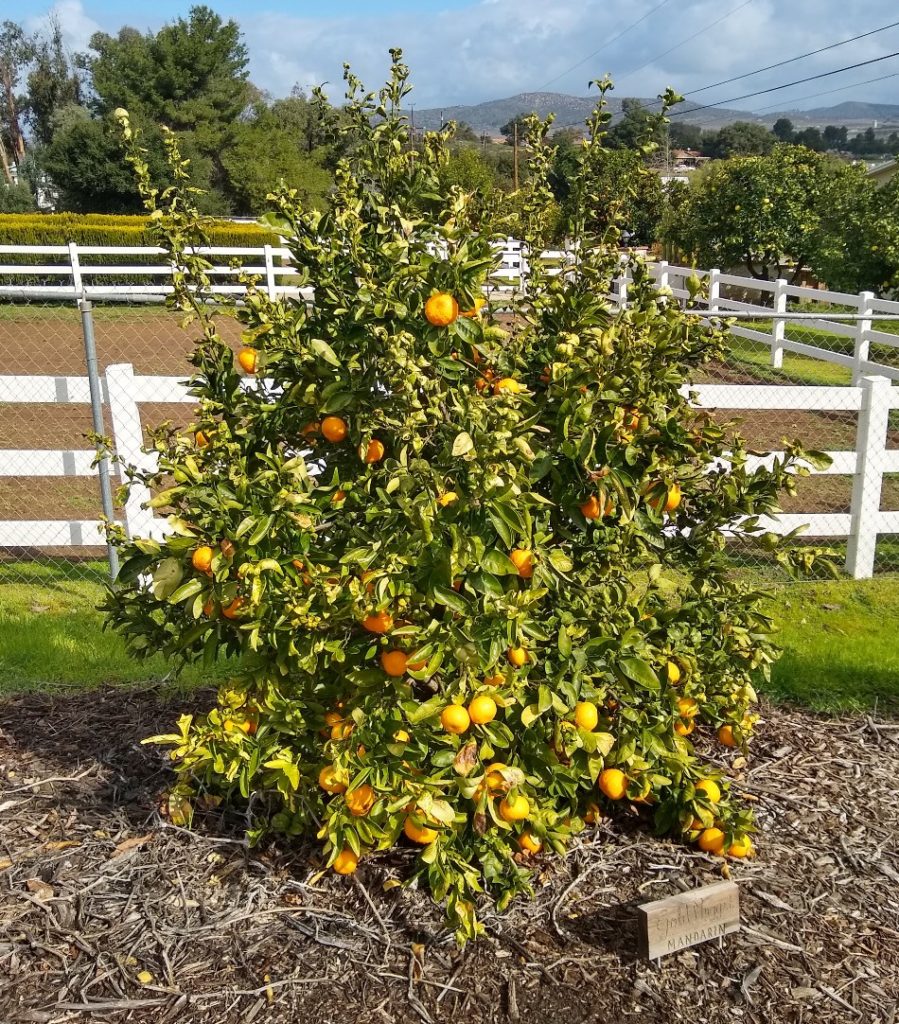
I am only able to keep Gold Nuggets on my tree into May and June if they’re high up or deep inside because my routine is to give my kids the green light to pick from the tree starting at the end of February, on my oldest son’s birthday. This is how the tree looked soon after I let them at it in 2020:
Here is how it looked a month later, on March 26, 2020:
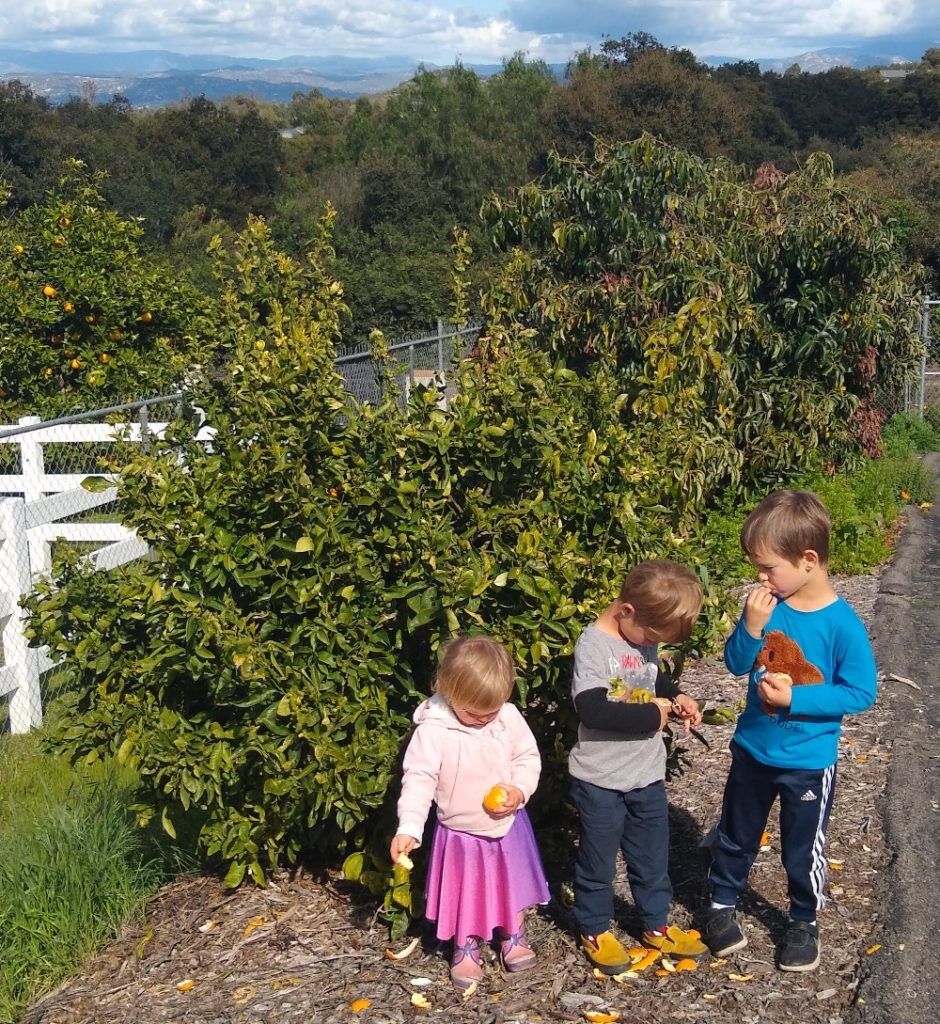
They wiped out a few hundred mandarins in a month that year. My wife and I enjoyed a relative few.
Six years later, here in 2026, almost nothing has changed except that the warm winter hastened the Gold Nugget season such that I allowed the kids to pick starting at the beginning of February.
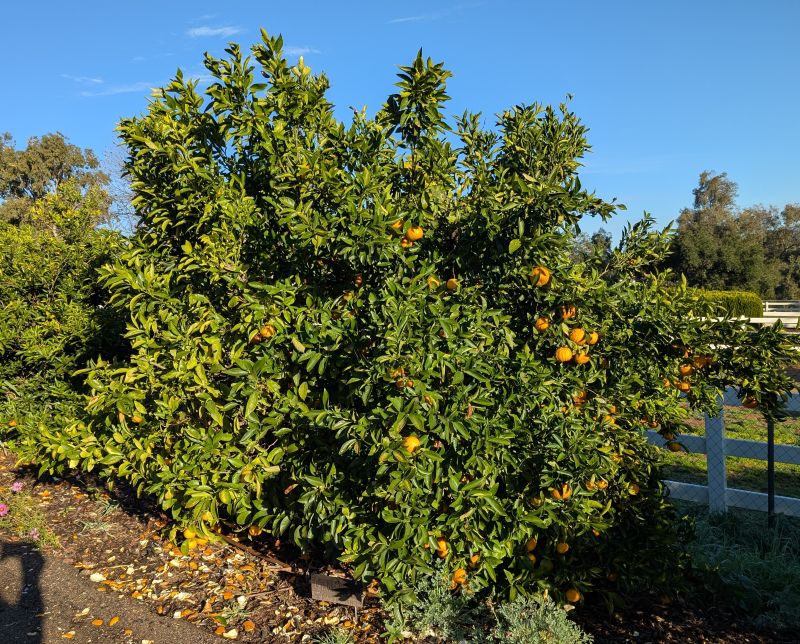
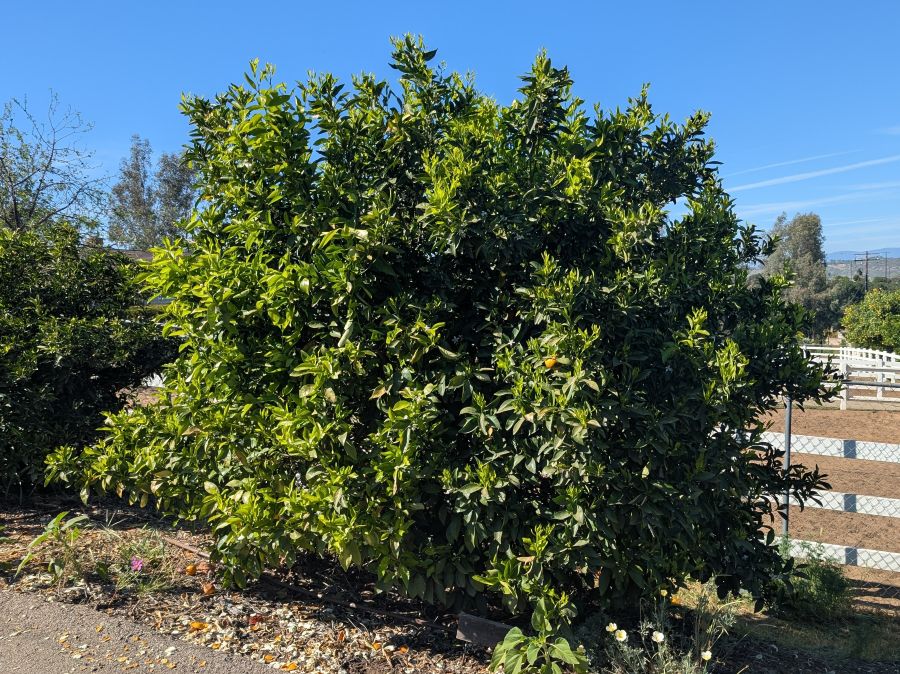
Our Gold Nugget tree today, March 27, 2026:
Where to buy a Gold Nugget mandarin tree
They are widely available at retail nurseries and garden centers throughout California. But if you can’t find one nearby, order from Four Winds Growers, who makes great citrus trees and can ship a Gold Nugget mandarin tree to your door.
Why Gold Nugget mandarins are becoming less common in grocery stores
Now is a good time to plant your own Gold Nugget mandarin tree because it is getting harder by the day to find the fruit to buy. Anymore, I only notice Gold Nuggets for sale at farmers markets and through the websites of farmers who sell direct, but rarely in mainstream grocery stores.
I recently learned why. Remember when I mentioned earlier that a Gold Nugget’s rind is both bumpy and releases heaps of aroma and oil when you peel it? These qualities are a problem in the context of large-scale farming and fruit handling.
The bumps on the Gold Nugget rind are vulnerable to damage during harvest and handling after harvest. The bumps are protrusions that receive concentrated pressure.
Another mandarin that has a similarly bumpy rind is Shiranui, often sold as Dekopon or under the trade name “Sumo.” And so you also find Shiranui mandarins with damaged rinds.
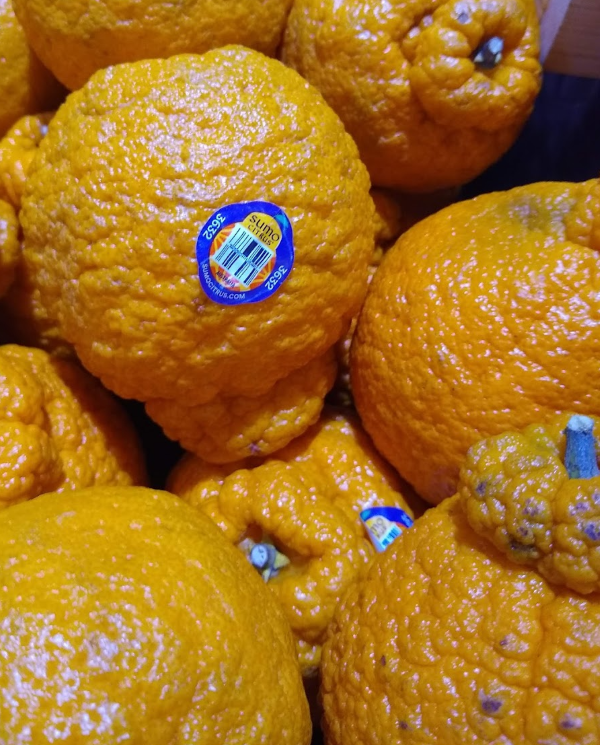
But with Gold Nuggets there is the additional factor of higher oil within the rind. When the bumps on the rind receive enough pressure, the cells rupture and the oil is released. The oil is phytotoxic to the surrounding rind tissue and causes brown spots to appear. No one wants to buy mandarins with brown spots all over them.
Consider how a Gold Nugget mandarin would get from a tree to a grocery store shelf. It is picked and placed in a bin. If it’s on bottom, there can be a lot of pressure from other fruit on top. Then it goes to a packinghouse where it rolls and bounces along “the line” and is cleaned with brushes. Every part of this process can cause rind-cell rupture.
A long-time citrus harvester and packer told me how Gold Nuggets have to be treated extra carefully in order to prevent rind damage. He said they must be placed in smaller crates holding around 20 pounds of fruit rather than the larger bins that can be used for less delicate mandarin varieties. Then at the packinghouse, the cleaning brushes must have softer bristles and the packing line must be run more slowly, at nearly half the speed as it can be run for less delicate mandarin varieties.
So citrus farmers, packers, and marketers have been moving away from Gold Nuggets, despite the variety’s unambiguously delicious eating quality inside. It is just straightforward economics. The incentive is, rather, to farm, pack, and sell mandarin varieties that are tougher and therefore cheaper to get from tree to store.
For example: “The joke is that W. Murcott can be thrown against a wall and it still won’t show damage,” a different citrus packer told me. (W. Murcott Afourer is a mandarin variety that is often included in bags sold under trade names like “Cuties.”)
But hey! None of this matters for a tree in your yard!
Videos
Here is my video profile of the Gold Nugget mandarin tree:
Here is a video where I compare Gold Nugget to other good mid-to-late season mandarin varieties:
Here is a video of parts of that 2012 Tour of the Citrus Variety Collection at UC Riverside (we arrive at the Gold Nugget tree at minute 42):
If you appreciate my Yard Posts, please consider supporting my efforts. They are all freely accessible, and I run no ads on the website so that you can enjoy the content without interruption. Thanks.
All of my Yard Posts are listed here.


I bought some Gold Nuggets from Sprouts the other day and was my first time trying. My wife and I both loved them and they were very easy to peel. I skipped over this one from the CCCP when grafting my Citrus cocktail tree this spring (Accidentally knocked off my Oro Blanco Graft I put last October during the process, It was growing branches already, Darn it for not being careful!!!).
I’m going to get some of these gold nuggets from the CCCP and graft them on two different large root suckers I have left. Thanks for the post, I was having a hard time chosing a nice Mandarin that is sweet and peels easy, now my choice is made. Thanks
I was mistaken, I thought I saw Gold Nugget on CCCP website, but it was Honey Mandarin. Bummer……
Hi James,
Too bad. I believe the reason Gold Nugget budwood is not available from CCPP is because it is still under patent.
But the good news is that Gold Nugget trees are widely available since both Durling and La Verne nurseries grow them. You should be able to find a tree to buy or order from almost any retail nursery. Also, Four Winds Growers carries Gold Nugget so you could have one shipped to your door from them.
Thanks, Found one 15 gallon at Louie’s Nursery today in Riverside, picked it up this morning going in the ground this weekend!
That was fast!
Wow, 6 years went by fast! For the past 2 years my gold nugget has been very productive to the point that it has had so many fruit that multiple branches have collapsed due to the weight. I’m on a SW facing hillside in Whittier and May/June have been when they are the best, through we started this year in March as we’ve had so much sun. Good Stuff!
Hi Greg
I have an ojai pixie in a container. I would like to plant another mandarin tree in the ground that would produce fruit during months that the pixie is not producing. I read your kids love kishu, I don’t have kids, would you still recommend the kishu or a different variety? I live in zone 10. Looking for seedless and easy to peel.
Thanks
Hi Jay,
To complement your Pixie, you might choose a Kishu or Satsuma (both of which are seedless and easy to peel, in addition to having an earlier harvest than Pixie).
Satsumas are bigger than Kishus, and they have larger juice vesicles. Satsumas are more of a type of mandarin than a specific variety, but they all taste about the same to me. I have Owari and Xie Shan. There are many others. Some people rate them as the best tasting of all mandarins.
Kishus are very small, the smallest mandarins I know. This annoys some people. I don’t mind because they’re so easy (and clean) to peel that I can harvest, peel, and eat four in the amount of time I can harvest, peel, and eat one other larger mandarin (most of which don’t peel as easily or cleanly as Kishu). Plus, if I want a quick, tiny snack, then I pick just one. Large mandarins like Shiranui or Shasta Gold are sometimes more than I want at one moment. It’s personal preference.
I have 2 Golden Nugget Trees planted them 13 yrs ago, in 2 very different locations. They were in 10gal cans. And one had some good size tangeries on it. That tree continued to bear xlnt delicious fruit, until 2yrs ago. Then all the tangerines were very tasteless, & very dry & fibrous. (We had over 30inches of rain that previous year)..Yet my other Golden Nugget tree in a different location had hundreds of tangerines & are always delicious. This year the fibrous tree had xlnt sweet & juicy fruit.
My other tree reached 22′ ft in height & with an 8ft spread. & a few branches cracked last year & split.. which I removed. And the heavy bearer & grower is in a more shaded area, & gets mostly just morning sun. And I love that the tangerines when picked can last months in the refrigerator. I bought these trees at Sperling Nursery which sadly closed 7 yrs ago located in Calabasas CA (8 miles from my house) Most of their trees & shrubs came from Monrovia Nursery in Monrovia CA. And my Golden Nuggets were from.Monrovia Nursery. My smaller Golden Nugget has very low branches, & I was able to get smaller low branches to root, by scatching the low branch with a knife & burying it in the soil.. & keeping it wet. In a few wks I had roots coming from the scratched area under the soil. And let it grow awhile before cutting the branch from the main tree. This always works with fig trees, & many other trees, & plants for me. And I expected it would work with my Citrus trees too. Which proved it did. 😃
Such helpful information about the layering, thanks.
I’ve just bought one in Tasmania, hoping they’ll tolerate the cold. Never seen them available here before.
We have a honey and a satsuma mandarin here and they’re both really good. I’ve seen the gold nugget for sale all the time. Maybe I should consider putting a graft on one of my trees. I’m guessing the patent has expired. My two cents: the best citrus in our yard is hands down the lavender gem tangelo (and we have some really tasty citrus here)
Hi Bob,
What is a Lavendar Gem tangelo? I’ve never heard of it, but even the name is very enticing.
I understand it’s a cross between something mostly grapefruit and some tangerine or something like that. I don’t use this word ever, but I would describe its flavor as exquisite. It peels easily, very reddish, juicy and tastes absolutely great (lots of seeds but they remove well). We eat it directly or use it as a 50/50 mix with tequila. It’s grafted onto my Marsh grapefruit tree along with a Cocktail grapefruit so we’ve aptly name that tree the tequila tree. I can’t find pictures of the fruit on my phone but I bet my wife or kids have one. I’ll send you that if I find it.
That’s the best name for such a tree: The Tequila Tree! Look forward to finding out more about Lavendar Gem. I’ve been enjoying juicing the Cocktail grapefruit from my neighbor’s tree the past few weeks — tastes so good it seems artificial.
does it require alot of heat to sweeten? was looking at a tangelo and could be worth a try, but coastal SF bay area so sunny but not hot
Glad to hear that about the lavender gem tangelo – I just bought one from Four Winds Growers on a whim.
i got one a few years back. it was starting to produce a couple of fruits but was still in a pot. then that summer heatwave of 2018 hit it and fried it pretty good but it was still alive. i put it into the ground in feb of 2019 and over a year later..it literally has not grown or lost any leaves. i compared before/after pics and it looks like i bought a plastic plant.
i’m not sure what the cause of this is…is it far too damage from the heat? it’s properly mulched and water on a timer and i’ve given it a bit of fertilizer but held off thinking it was pretty stress. i’m almost to the point where i might just dig it back up and replace with another one at this rate.
Just a guess, circling roots.
Planted a fish tail palm years ago, it did nothing for ten years.
Dug it up and put in a 5 gal bucket to sell it, started to grow new fronds.
Hi Johnny,
Bummer about your tree. Dennis has a good guess there. In the past, I’ve removed a couple young citrus trees that didn’t grow and found that both had circling roots near the crown; they seemed to be girdling each other and preventing the tree from thriving.
I think your idea of replacing the tree is the best solution regardless of the cause.
Hi Greg,
My golden nugget has been in the ground (and out of the 5 gallon container) for about 3 years now. It’s about 8 feet tall, and at present covered in hundreds of flowers. I notice that many of the flowers appear to have been pollinated as I can see the tiny fruits attached. That said, I feel like most all of the fruits aren’t getting bigger and some may even dry out an fall off. Any ideas why that might be? I do apply a citrus fertilizer 4 times a year (Down to Earth) brand. Thanks!
Hi Andy,
Nothing sounds wrong with your tree. Some flowers become fruit and some don’t. Only if it has many flowers yet few fruit result should we worry.
I have 6 gold nugget trees. They do alternate bear. I got one tree from Home Depot and the rest from Evergreen Nursery. May 15, 2015 I went on an Alaskan cruise leaving from Seattle. I went to the market there and what did I see? Gold Nuggets. I bought about 10 and after the cruise I wanted to get more heading home, but didn’t have the time to go to the big market there. Once you start eating these you can’t get enough. I have 3 Tahoe Gold tangerine trees. It is the best of the Gold series, the other 2 being the Yosemite Gold (2nd best), and the Shasta Gold. The Tahoe Gold were early this year – they don’t peal easy, but the fragrance is bold and amazing as is the taste and sweetness – these are the juiciest of any citrus. Pealing it leaves your hands smelling like tangerines for hours. I can’t pick a best because of varying qualities, but everyone should have Gold Nugget and Tahoe Gold. Then add Pixie and the others that Greg mentioned if you have room.
Thanks for that, Richard. I too can’t pick a best mandarin, but I would hate to give up my Gold Nugget. Six Gold Nugget trees! That is a testimony right there.
With multiple gold nugget trees and they alternate bear can you force them to alternate different from each other so each year you have some?
Hi Jason,
Yes. You can also train an individual tree to alternate bear in different halves of its canopy.
Hi,
I think my gold nugget either has a disease or a deficiency or something, because many of the early new leaves were super pale, curled, and some developed a white area along each side of the central vein. Can anyone help with a possible diagnosis?
The tree was only just planted by a gardener in early September 2019, so it has yet to have any flowers or fruit. I am in North San Diego County, about 2 miles from the coast.
Thanks for any advice! I would like to share a picture, but I don’t see where to do that.
Hi Heather,
I’d wait a couple months to get worried about your Gold Nugget tree. New citrus leaves always look somewhat pale when they first emerge, and on some varieties they are very pale. My Gold Nugget’s new leaves are tiny and yellow right now. If they are still yellow instead of lime green when they reach full size, then worry.
Sometimes aphids infest new citrus leaves and cause them to curl. Uncurl leaves to check if there are tiny bugs inside.
OK, thank you Greg! I will keep an eye on it. I did find a few aphids, but most of the curled leaves did not have them. I’ll see what happens over the next few months.
Thanks,
-Heather
Damn I was excited because I’m in the market for another citrus tree… turns out all the blooms on my mandarin fell off and only about 2 fruit are forming. Time for a new tree but that alternate bearing issue is a deal breaker. Guess I’ll be getting that Satsuma Owari unless you have any other suggestions? Want a nice sweet mandarin that’s seedless.
Hope you and yours are healthy and safe and hunkered down enjoying your garden in spring. I finally put my Fruit Punch Mango planted in a raised mound. It’s already pushing new growth and I have a new bee colony after the last one I had was abandoned.
Hi Zen,
There are so many sweet mandarins that are seedless. Satsumas are one, and Kishu, Pixie, USDA 88-2, Tango, and more.
Same to you. This is a nice time of year to be hunkered down, if we have to.
Honey mandarin is pretty good. You often find them on fruit cocktail trees with lemons, oranges, etc. Also, the satsuma is considered a very early citrus (or late depending on the metric). Ours is near SDSU and comes in around November or so. I think if we were in a hotter area it would be ready in October or September.
I would so like to join you citrus growers! Unfortunately, the only available land is a hillside that is covered in ivy. I have cleared ivy in one semi-level area about 6’x6’, digging out ivy roots to about 12-14”. I can’t clear much further due to grade and property line constraints. Knowing ivy’s tenacity, I suspect it will keep coming back. Is there any way to eradicate it without harming the soil for a citrus tree? Alternately, is it feasible to plant a citrus and then just try to pull any ivy that reappears or will the ivy compete too much with the citrus for soil nutrients?
Thanks for feedback.
I have a steep hillside and have to keep the ivy to prevent erosion. I dug holes and planted my trees in 50/50 enriched soil and I use a plastic edging on the level edge. I let the ivy grow around the edging and weed wack it a couple times a year and use a hedge trimmer on the ivy that grows over the upper edge. Use wood bark chip mulch in the 24″ or larger circle the tree is planted in. Also, install a watering system on automatic because if you let it dry out 1 time the tree is history. The ivy is only a problem if you let it over grow for a long time.
I live in Riverside. My husband and I bought our Gold Nugget at a local nursery as soon as they were released. In the past 3 to 4 years I noticed large round shaped fruit full of seeds that would fall off before ripening. I was told that was from the rootstock as the branches had long thorns. We pruned a large section of the inside of the tree that contained these branches. My tree is actively bearing fruit and it is ripening here in December.
Hi Michelle,
Glad you caught the rootstock and removed it. Reminds me to poke into the canopies of my trees to check for rootstock. Think I’ll do that today.
We have a “Gold Nugget Mandarin” in a half barrel, when is the best time to move it either to a new barrel or just plant it in the ground.
Hi Albert,
I’d do that work any day of the year, unless your yard typically gets to the mid or low 20s in the winter. I’ve done such transplanting of citrus in the dead of winter and at the height of summer. Both work fine, as does any time in between. I planted my own Gold Nugget in the middle of January in 2015.
I sometimes say that around May is the best time to plant or transplant citrus just because the tree will immediately start growing and that can be satisfying to watch, but any other time is fine too.
I have a golden nugget in the Phoenix area. Planted a year ago and seems to have curly leaves. Is this normal or does it require more water than typical citrus? Thanks
Hi Ryan,
I have always watered my Gold Nugget the same as all other adjacent citrus so I don’t think it has different needs. Gold Nuggets do have curly (kind of ugly) leaves, naturally. Every one I’ve seen in different climates has it.
I bought a gold nugget from sloats nursery about 1.5 months ago and it says it’s on standard rootstock. I couldn’t see an obvious graft point but it just looks like a small rooted branch. Is that normal? It also hasn’t produced any new growth or looks any different from when I first bought it! Should I be worried?
Hi Regina,
It’s possible that the tree was budded (grafted) so well that the union isn’t easy to spot, but usually you can find some swelling or line on the trunk.
I don’t know for sure about the Bay Area, but down here Gold Nuggets (and citrus generally) are blooming and flushing new leaves right now. I guess it’s possible that your tree has already finished. Do you see any tiny fruitlets on it? Do the leaves look green and healthy? If so, then I wouldn’t worry.
Greg,
Can I buy a few scions from your golden nugget? I would like to graft them on to my existing mandarin tree.
Thanks,
Tony Cipponeri
Hi Tony,
You can get budwood for Gold Nugget from the Citrus Clonal Protection Program: https://ccpp.ucr.edu/onlineOrdersV2/
That’s the smartest, safest, and only legal way to get such citrus budwood these days. One of the main reasons to use this source is because their trees are tested and known to not be infected with HLB or other citrus diseases. I’ve ordered many scions from the program myself; it’s easy, reliable, and reasonably priced.
Hi, I also had success with the Gold Nugget tree, it is a strong grower and I like the fruit very much. But one tree I always wanted in addition was the Satsuma. I tried different trees but they always struggle at my place in hotter inland. Their worst time is October and November then they look very droopy. There is a lot of die-back and trees overall stay very small. Extra water, fertilizer, insecticide, or fungicide don’t seem to help. Is this strange, especially compared to other trees doing fine? Is it time to accept the incompatibility and to give up? I hope somebody has advice, thank you, Kay
Hi Kay,
It’s just Satsuma trees that grow poorly? I know that Satsumas can grow very well with inland heat. They do fine at my place and in Riverside, for example. It might have been the particular trees (circling roots in the pot can be an issue) or it might have been the particular spot in which you planted them (shallow soil or poor drainage or something else).
thanks, good to know that inland heat is not a problem. I kept searching and think I found a new fungus in SoCal can be the reason. It is called ‘Colletotrichum’ and causes dieback. It will fit the symptoms (still funny that the Gold Nugget tree seems fine). I tried fungicides before because I suspected Phytophthora, but they didn’t help. Now I will try again with different ones.
To celebrate buying our 1st home, in Los Angeles, I ordered a golden nugget sapling from four winds in FL. It’s been a year, and I put a ground collar around it to water and fertilize. It had some small fragrant buds last year, but no real fruit. This year, it developed a bunch of chartreuse leaves (not the dark green it started with) that have just fallen off, and now it looks like large twig. What did I do wrong? That part of the yard gets less sun in the winter, but could that cause complete failure?
Hi Khymn,
Sorry to hear about this. Sounds like possible overwatering. Right now is when the tree should be growing new leaves (chartreuse colored at first) and blooming. Lack of sun isn’t ideal but shouldn’t cause total failure; lack of sun could contribute to overwatering though, as the tree has less need for water compared to a full sun location.
I have room for one citrus tree, and would like a sweet, seedless and easy to peel mandarin. Which variety would you recommend? Thanks!
Hi Judy,
What a fun question! There are actually many good options to choose from. I think you would be happy with any of the following varieties which all satisfy those criteria: Gold Nugget, Tango, Kishu (very small fruit), Gold Series (Tahoe Gold, Yosemite Gold, Shasta Gold — all of which have big fruit), Pixie, Satsuma (Owari is most common), USDA 88-2 (also called Lee x Nova, Supernova, Superna).
My personal favorites are the Kishu for early season, and the Gold Nugget for late season.
You can source most of these varieties at Four Winds Growers or ask your local nursery for a supplier.
I guess I should have read my email yesterday to see that you just revisited the topic of the Golden Nugget and Shiranui… and there I was talking about them at the visit with Ursula today.
Thanks to you and your generous family for sharing your time and knowledge… and how much your kids have grown since you originally wrote this post! I meant to ask which was responsible for the cool eagle?
(I’m the one who was wearing the really cool hat.)
Hello,
I have been trying to purchase Golden nugget trees (or seeds) and can not find any place that carries or sells them. I am in Fallbrook CA. Any ideas?
Todd, did you have any luck locating a Gold Nugget tree? I’m looking for a late season citrus to complement my Lee x Nova. If I do not have any luck with the Gold Nugget search, I may look at Satsuma, Sumo, Tahoe OR Shasta Gold varieties.
Walter Anderson in Poway has some Gold Nugget trees. I just bought my first one yesterday.
Got one of them too from Poway today!! Thanks, Helen, for comment. 🙂
Hi Greg, thanks for the wonderful information on the gold nugget, we just planted one! Would love to know where to get a Pixie tangerine tree if you would share how you came to have yours. Thanks!
Hi Randy,
Thank you. La Verne Nursery (wholesale) makes Pixie tangerine trees for retail nurseries all over Southern California. You can go to your local nursery and ask them to order one from La Verne for you if they don’t have any in stock.
Hey Greg,
I just bought a 5 gal Gold Nugget from Walter Andersen. It looks like a whip with little side branching and a lollipop of leaves on top. It says it is a standard tree, but I have read your blog for a long time and know that means trained for a central leader. How can I force lower branching? I am pretty sure it is on Carrizo rootstock. I also picked the tree with the most side branching from what they had. Any advise to make it short and bushy? Thanks.
Hi Dan,
All they do to make those “standard” trees is cut off all the side branching down low, but if you do nothing you will probably get some new growth on that lower trunk, which you can allow to grow. That’s what I would do: nothing and wait. But I would also be sure that the bare trunk doesn’t get sunburned in the meantime. Protect it with a wrap (I often use shade cloth) or white latex paint or something similar.
You could make a heading cut on the tree to try to force low branching, but I wouldn’t do that. Then you’d be dealing with a bare stick and you’d have to be careful not to overwater it and protect it from the sun, and you risk the little guy just dying instead of regrowing.
Hi Greg,
Thank you SOOO much for this detailed post. I have a Gold Nugget for 12 years but it’s been moved twice because soils in my yard are terribly clayey. The tree never flowers or bears fruit. It does have few branches with green leaves which tells me it’s still alive. I moved it to a 20 gallon wooden planter box this morning which means it’s the 3rd time it’s been moved. What can I do to make sure it grows & bears fruit? Reading your post give me hope this tree can thrive if I give it more care.
Hi Greg!
My husband and I moved into a home that had a mandarin orange tree that was young and very healthy. We lived there for about 9 years and enjoyed those mandarins every year. Our mandarins were always requested by my extended family and friends. It was a good producer and then we decided to move into a new home and sell that house. I tried my best to graft the tree or to figure out what variety it was because there is about (roughly) a trillion different types haha.
We’ve lived in our new house for a year and a house and my biggest regret was not uprooting that tree and taking it with us. I knew I needed to figure out what it was. After I researched for an entire year, I came across the gold mandarin variety and was so hopeful it was the tree I’d been searching for. It seemed like a match so I went to our local nursery (Moon Valley) where they let us tase the fruit BEFORE buying the tree!!! (GAME CHANGER)!!!
Lo and behold they had one in stock as they are pretty rare, and I tried one of the fruit that was pretty green but once peeled was orange inside and did have the SAME perfect flavor!!!! I’m not kidding you, I wept. My husband (who is amazing and doesn’t think I’m totally insane) asked the sales rep to wrap it up and load it onto our truck! It’s in our ground doing so great!!! I’m going to buy at least two more.
My children love them. I actually eat them early- around mid February because I love their tartness. But they are so sweet in March. I love all of the great info you’ve provided! Thank you! Everyone needs this tree!!!
Wow, Dee. That is quite the testimony for Gold Nugget. And I thought I loved the variety!
It really is an amazing tree though, and I look forward to eating from mine each spring. Right now the fruit is just starting to turn orange so I can see how many we’ll have this year.
Haha yes! It’s the best!
Hi Greg! Wondering if you could help me with my Gold Nugget. I planted it in early 2021 from Four Winds actually because of reading about how much you love yours! It had its first big crop this year which has been delightful! However it seems to appear overtaken by what I would call suckers. However it is above the graft line, but just above about a few inches. Multiples branches sprouting out with big thorns. The leaf shape an are the same. Would you slike it these are suckers? I can provide pictures if needed. Thank you so much!
Hi Jen,
Thank you for your support! It sounds like those are vigorous new branches of Gold Nugget, and not rootstock. I have seen my own Gold Nugget do the same thing. As long as the leaves are not in groups of three, as seen in this post, you can be sure it’s not rootstock since Four Winds uses C-35 for rootstock on Gold Nugget:
https://gregalder.com/yardposts/beware-of-rootstock-suckers-on-citrus-trees/
Vigorous new branches of Gold Nugget are thorny and angular and upright. It might take a year or two before they flower and make fruit.
Some people prefer to cut such branches out, but I do not. There’s no right answer for all people and situations with this. As you will see from my updated Gold Nugget post (ready tomorrow), my tree has not suffered in productivity from simply allowing such vigorous new branches to become part of the canopy.
Thank you so much, Greg! That is super helpful information. I didn’t even think of checking which rootstock Four Winds uses for the Gold Nuggets. I did end up taking a few out that were growing very close and parallel to the main trunk and left others that were growing more outwardly. But I am glad to know that they are not rootstock. I was concerned because the smaller fruits it grew this year were smooth skinned and the larger ones were bumpy. All seedless though. My gold nugget just started flowering though so I did decide to remove all the fruit. Do you do the same? Or do you let them hang on so they get sweeter?
Hi Jen,
I let the fruit hang until the kids have eaten them all. Period!
But if it were up to me, I wouldn’t remove them at flowering time. I would simply pick them as I wanted to eat them regardless of flowering.
I live near Sanger, CA, home of Kings River Packing, and just came back from picking Gold Nuggets off two trees at my friend’s house. His trees are prolific and I’m so grateful because they are my absolute favorite citrus. The new buds are already starting to open, but there are hundreds and hundreds of mandarins still on the trees. I’m thinking I might see about planting one in our yard since I know they grow so well here. He told me to not even look for them at the stores anymore because the growers are all ripping them out for the reasons you stated above.