
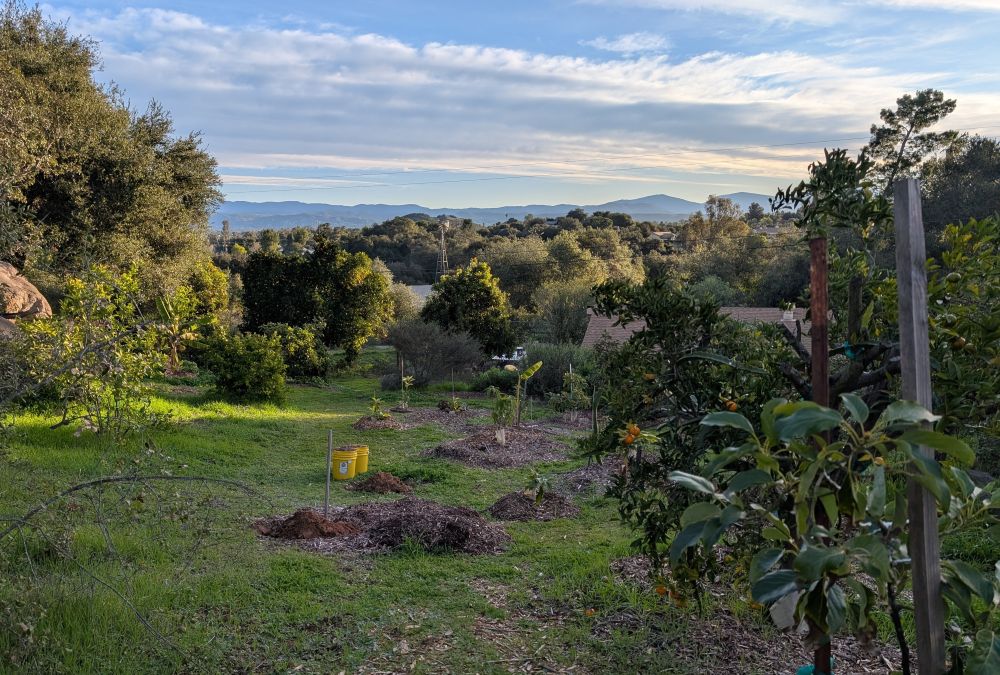
To help you make sense of, and apply to your own yard, the experiences I relate in my “Yard Posts,” I’d like to paint a picture of my yard’s physical aspects: where my yard is located, how big it is, the type of soil underneath, the climate above, and so on.
I’ll add some social aspects of my yard that are important to keep in mind, too.
Where
I’m twenty miles from the ocean, as the crow flies, in San Diego County.
Elevation
The area is called Ramona, and it is up in the foothills, above and out of sight from the valley communities below of Poway, Scripps Ranch, Lakeside, Rancho Bernardo, and Escondido. My land is at about 1,450 feet in elevation.
Temperature and humidity
The marine layer of fog that forms over the ocean and rolls over the coastal land each evening during most months of the year runs into the hills that separate the Ramona bench from the valleys below, and often the marine layer is too shallow to push up into Ramona. In June, it can be sunny and 100 degrees at home, and I will drive down the hill to the beach to find it fogged in and barely 70 degrees.
Because my yard is hotter and drier than yards to the west and lower in elevation, I have almost zero powdery mildew on grapes, squash, tomatoes, and cucumbers. On the other hand, I frequently get sunburn on tomatoes, avocados, and apricots. Yards only a handful of miles west and down the hill get much more powdery mildew and much less sunburn than mine.
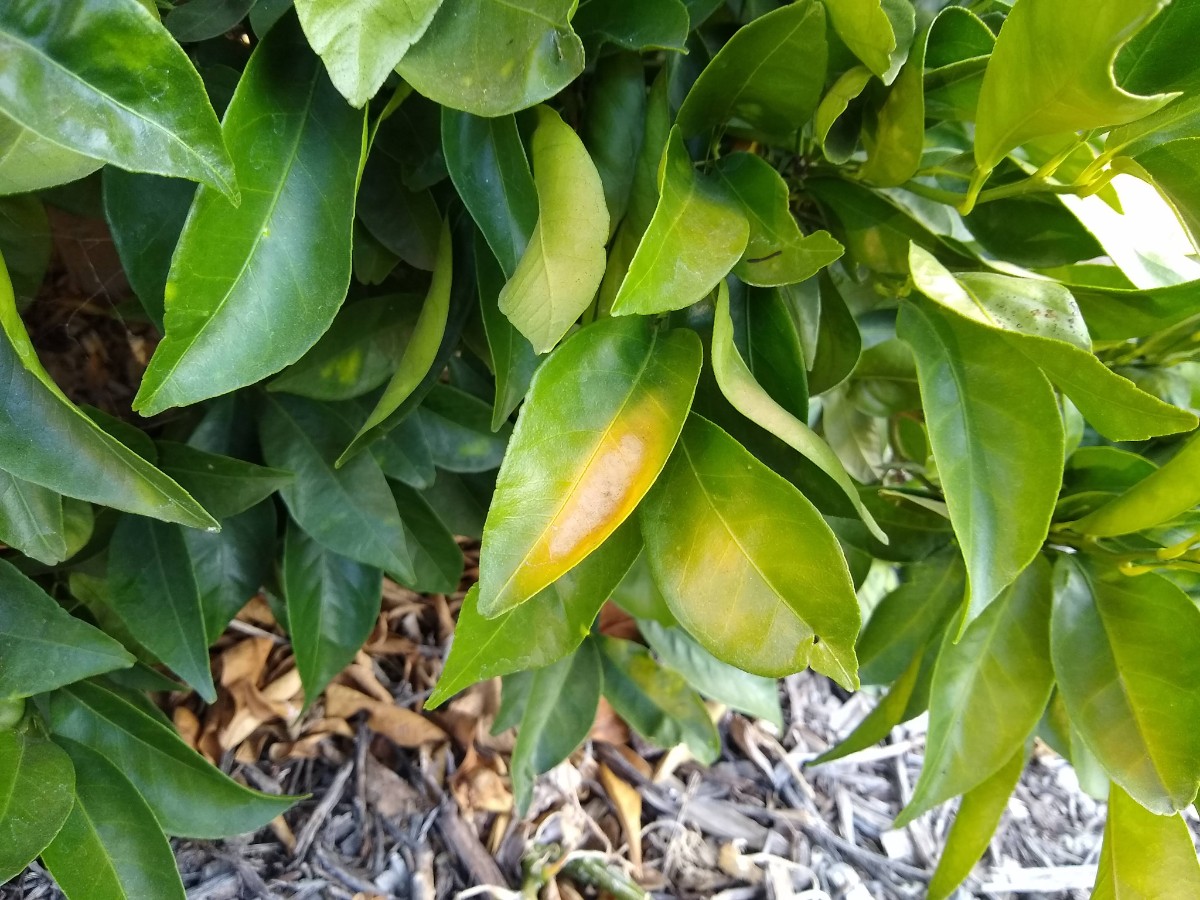
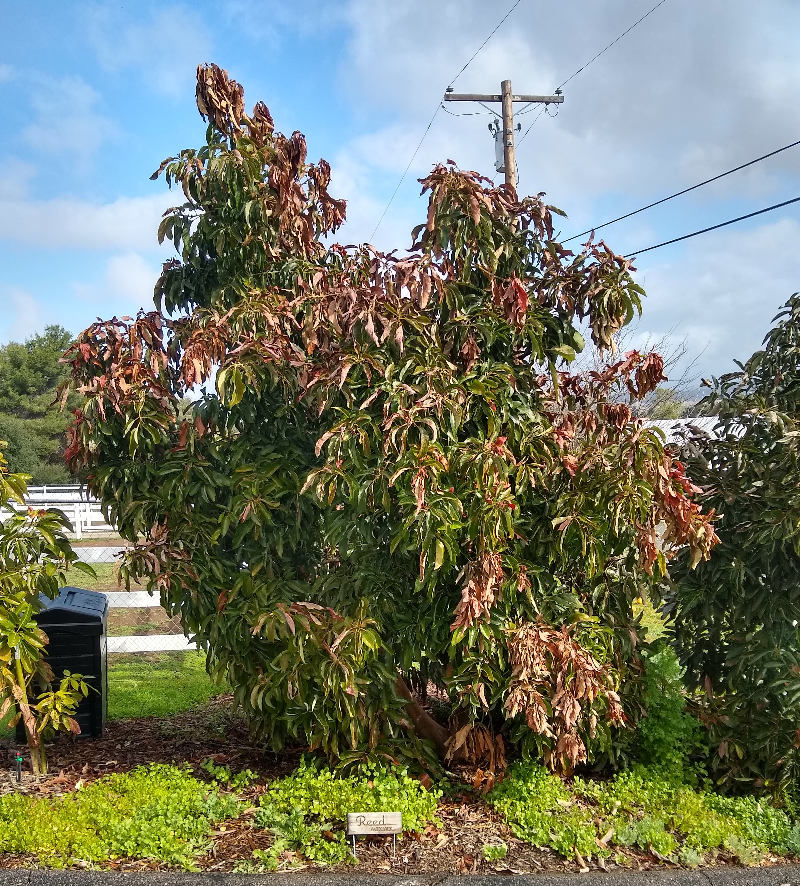
In the winter, my yard is relatively cold and wet too. The hills squeeze out a little more rain from the clouds onto our area. The elevation means that winter nights have more frost and more chill hours also. Almost every winter, my bananas, mangos, and avocados get some degree of cold damage. The coldest it has gotten in the past dozen years I’ve grown in this yard is 25 degrees. I’ve found only a few low-lying areas down the hill that get as cold at night as my place.
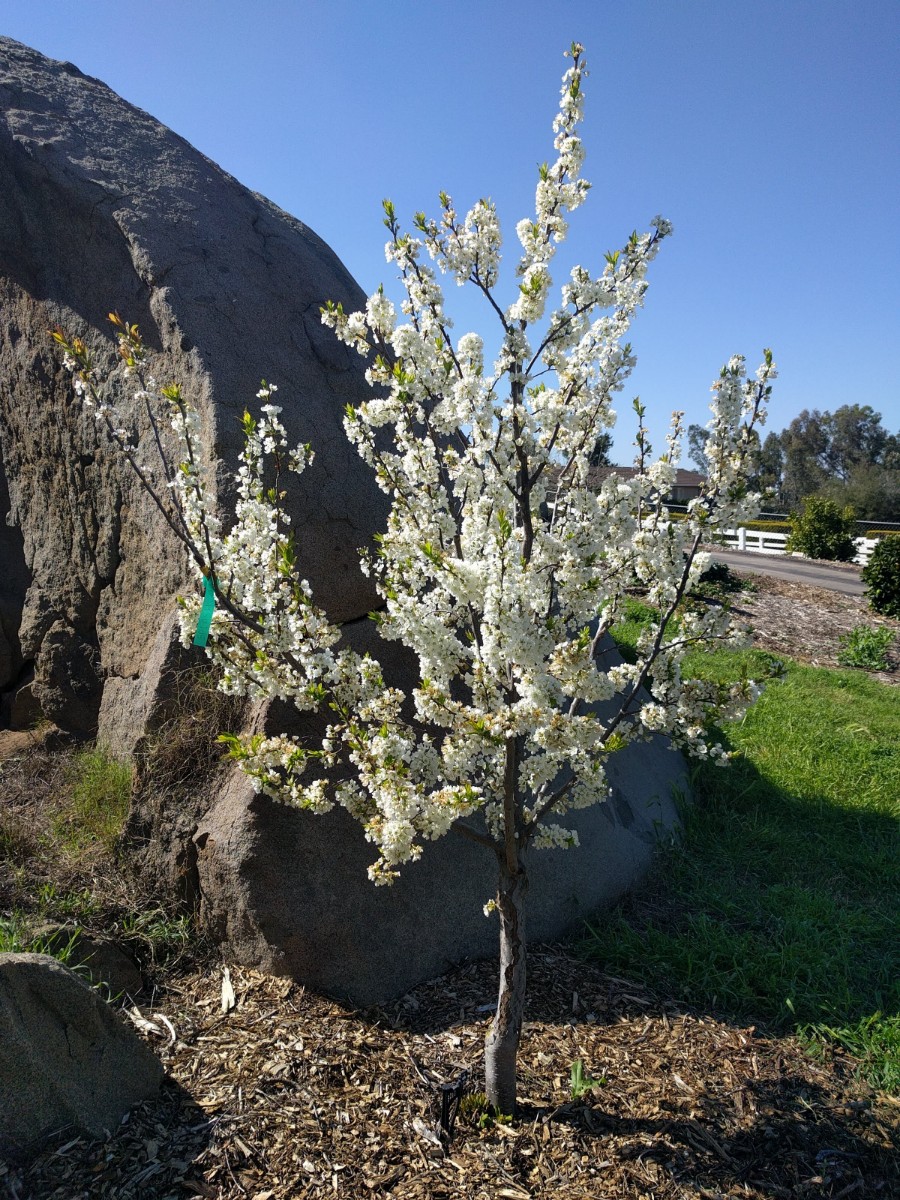
On the plus side, my fruit trees that like cold winters – apples, apricots, plums, pluots, peaches, nectarines, cherries, pears – have their winter chill requirements met easily in most years.
Size
The yard is 1.3 acres. This has been more than enough space to fulfill my goals of growing almost all (about 80 percent) of my family’s fruits and vegetables, plus chicken eggs, plus lots of extra avocados. I still leave approximately half of the property unirrigated and wild, covered with mostly native plants – oaks, sumacs, buckwheat, chamise.
(See “Keeping a corner wild” and “My yard, 10 years of growing”)
Slope
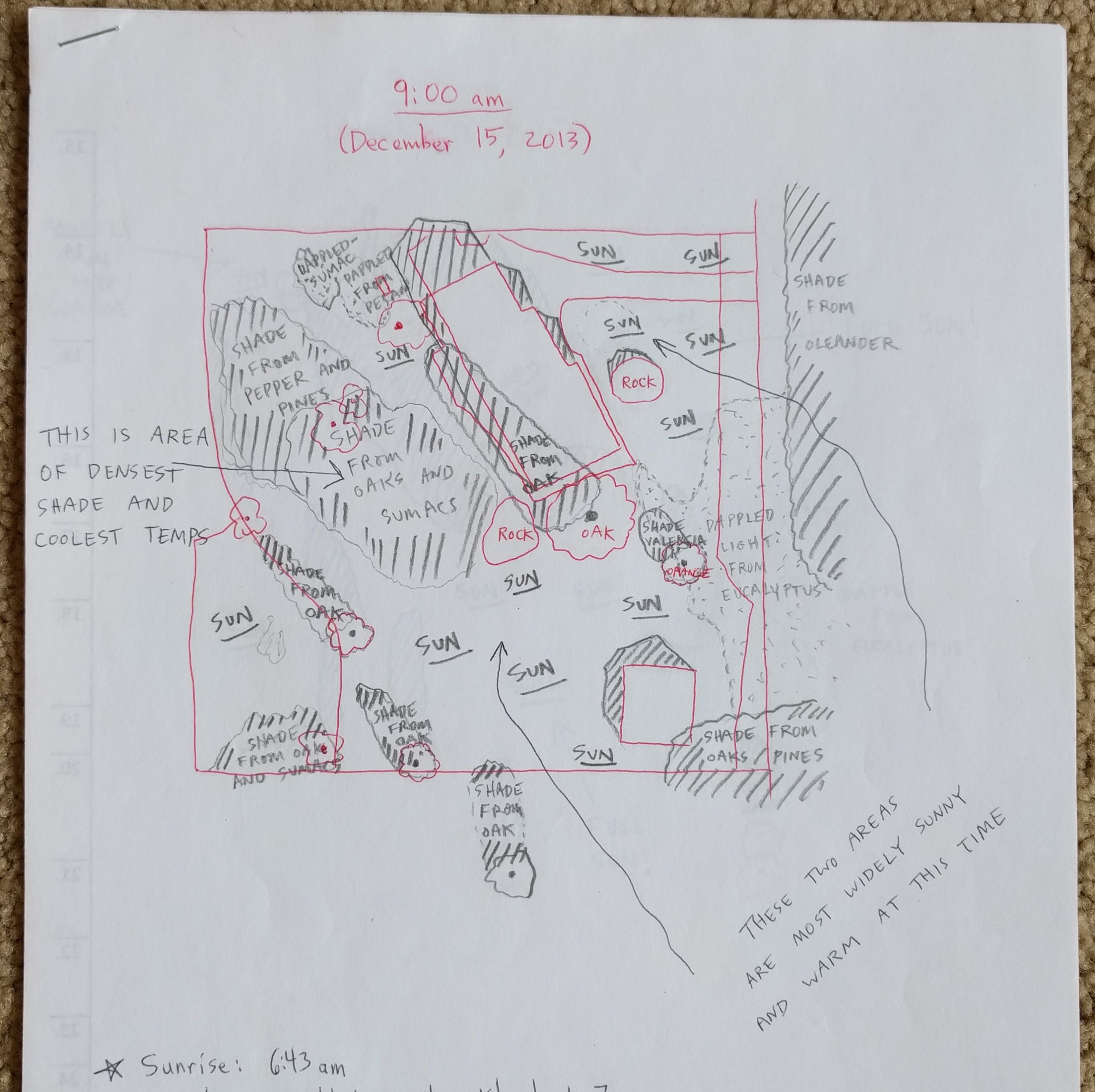
The land is on a gentle slope that faces the morning sun, east, but whose border reaches the top of the slope, such that there is no higher hill casting an afternoon shadow over it. Almost the entire acre gets full sun all day, all year long, except for a few spots near large oak trees.
Soil and stone
When my wife and I were looking for a house to buy in 2013, we arrived at this place and my wife entered the house to assess it. I walked the yard. I could live about anywhere as long as it had enough open space and good dirt. I scratched around and immediately knew that the soil was to my liking. It is a sandy loam, my favorite soil type. It’s so easy to dig and it also carries and holds some water and nutrients.
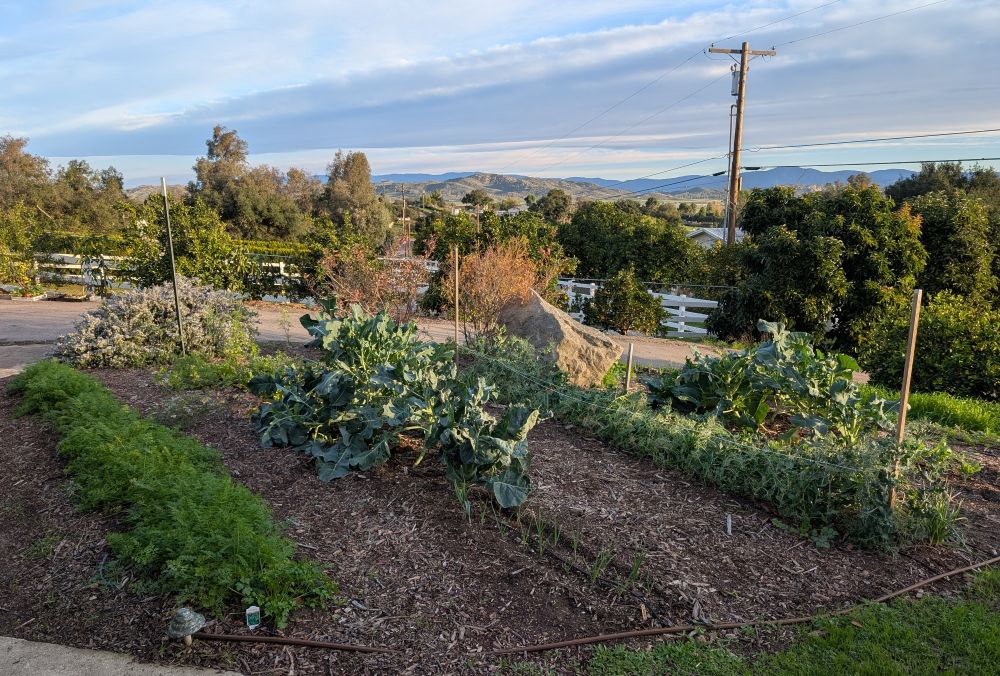
The soil is not a perfect and deep sandy loam throughout, however. Over the years as my plantings have expanded, I have discovered parts where the topsoil is thin (one shovel head in depth) and where there are numerous stones (watermelon down to fist size) hiding underneath.
There are also four groups of car-sized boulders. I have to carefully plant near these boulders because sometimes they are like tips of icebergs and their sides don’t go vertically into the dirt such that the dirt near them is only like a skin over their hidden bodies.
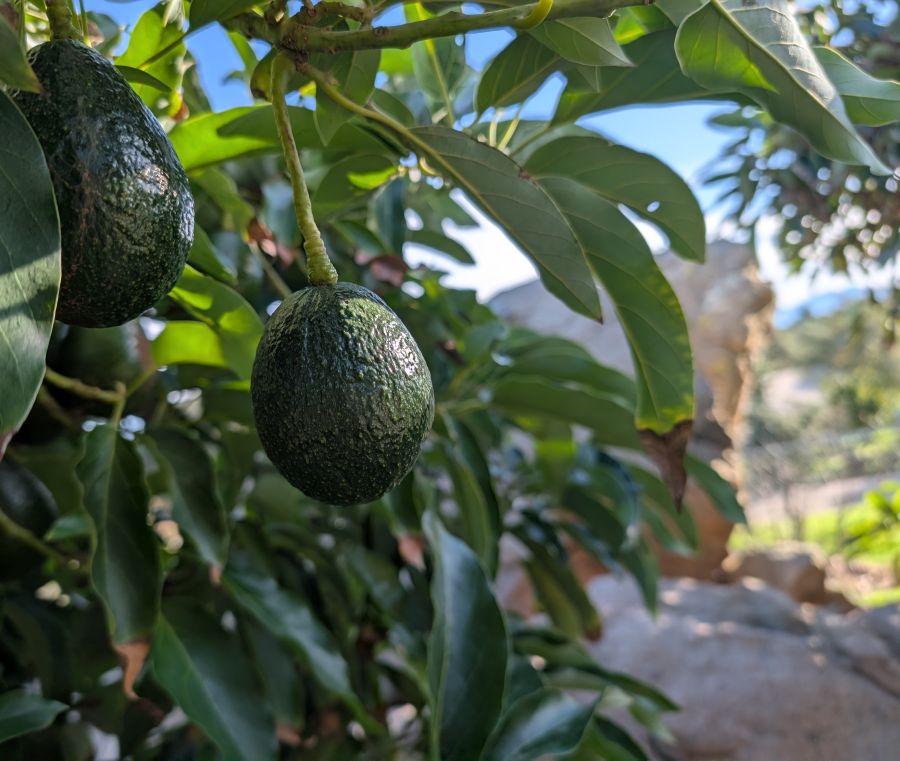
What is nice about these boulders is that they absorb and retain heat. This heat warms plants right next to the boulders throughout the night. I have noticed, for example, that B-type avocado trees make more fruit when planted next to the boulders.
(See “My soil, in depth”)
No hired help
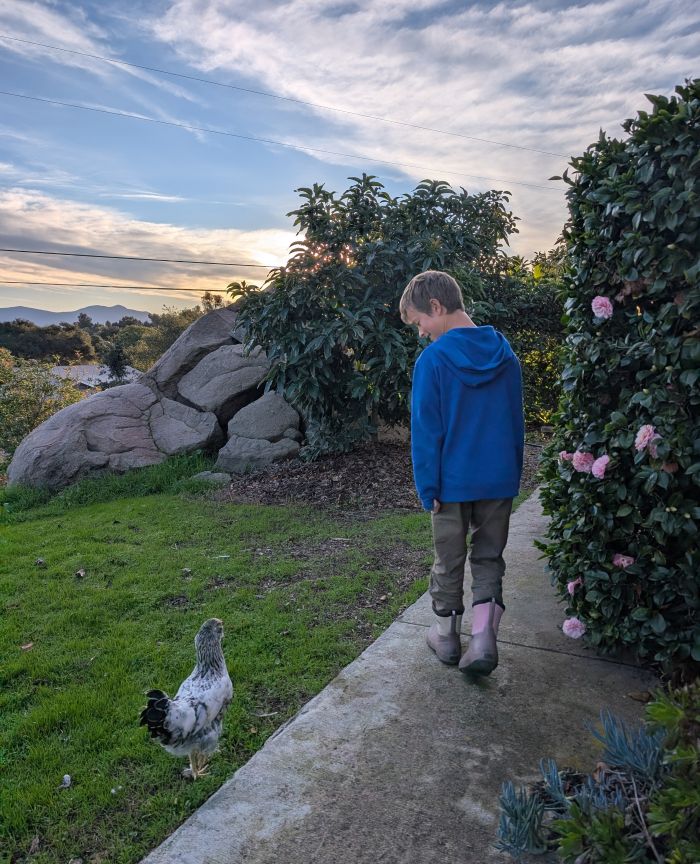
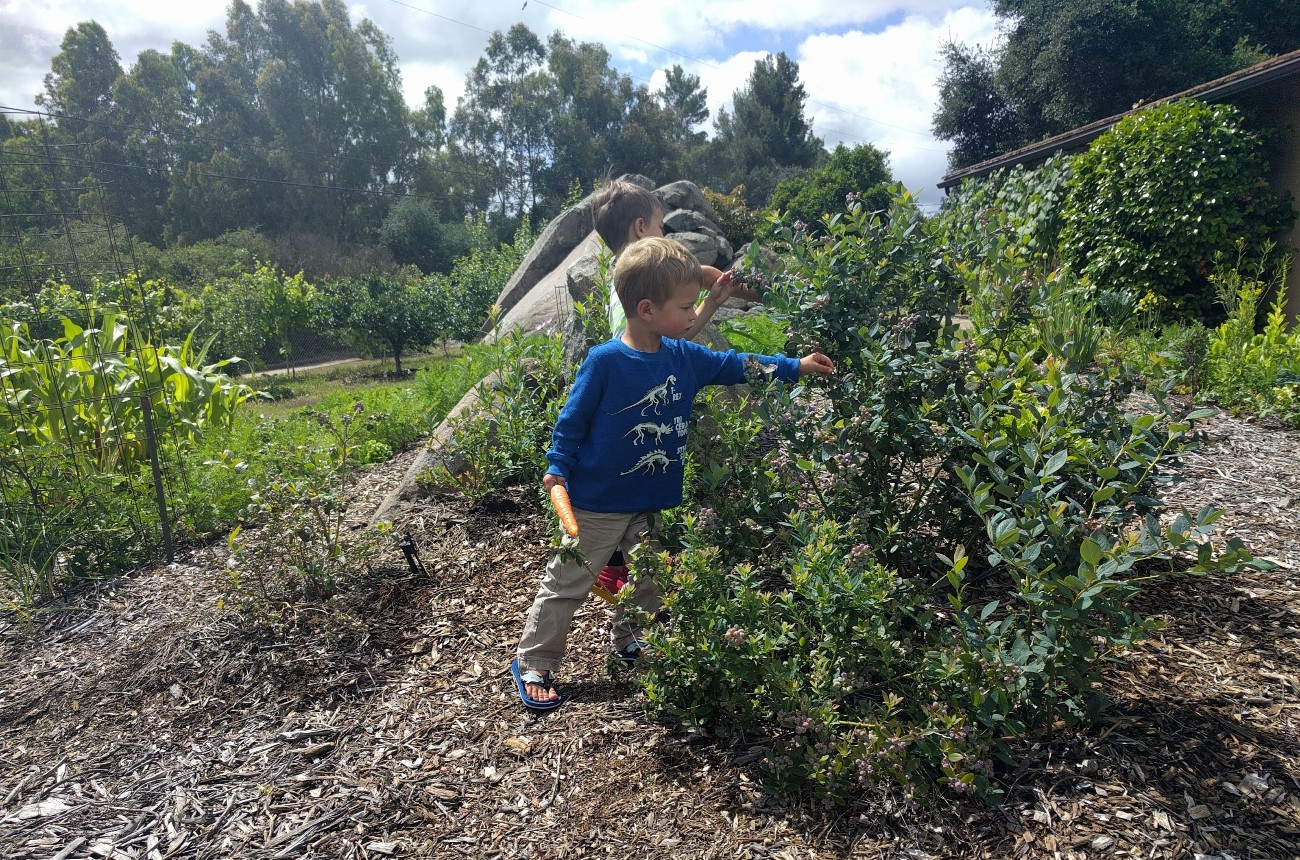
I have built this yard and I maintain this yard almost entirely myself. I have no hired help. My wife helps weed some vegetable beds every now and then. My children are out in the yard with me every day, but mostly to eat what I grow. They’re only now getting old enough to provide some help rather than just good company.
I tell you this for two reasons.
One, I ain’t no phony. (Got that, Holden Caulfield?) I’m not talking about how you can plant all of this and grow all of that as I then have some guy do the work for me. In my twelve years growing this yard I have twice paid for help, and it was to have oak trees trimmed that were too tall for my skills and tools, and to have a giant patch of cactus removed.
I like doing all the work myself. It’s good for my body and it’s good for my mind. I also like the confidence it gives me as I share experiences in my Yard Posts.
Two, this yard is not so pretty. I can’t keep up with it at certain times of the year. Weeds grow longer than I’d like, cats poop in the bed I prepared for sowing carrots, rain falls before I get my lettuce seedlings planted, I’m late on an irrigation during a summer heatwave.
But I’ve seen a lot of other food gardens that aren’t perfect too. Maybe yours is like mine: only one or two people are caring for it, alongside all of the other obligations of life.
All of our yards have climate, soil, and other limitations, but within them we grow special food and gain special satisfaction.
Thank you for your support of my yard and my family through your helpful comments on my Yard Posts over the years. And I appreciate your support of my Yard Posts so I can keep them coming and ad-free.
All of my Yard Posts are listed here

I see you’re growing a crop of great kids. Oh, and some trees and stuff, too.
Nice! Thanks, Randy.
Good read Greg. Be your own Farmer.
We bought our yard back in 2011. There were nine fruit trees and a few were dying. I now have over 50. And many more in pots growing to give to others. My main goal was to figure out what would grow in my climate. I am 5 miles to the beach. And I have clay soil. So I have been a wormer for over 25 years. I set out to fix the soil as much as possible. Using worm compost. And to grow a wide range of fruit. Cherimoya, bananas, Vernon Sapote grow here. I have twelve avocados when neighbors said nothing grows here but citrus. I do have some trees that are more difficult and others that grow better like Loquats love it here. Figs are difficult now, climate has shifted. You can have good years with pears and moving around plants can help with the weather. Bananas are near the house that helps them with the cold wind. It is essential to know your property and climate. It’s essential to understand your soil and make it nutrient dense. My husband and I do it all as well we have an acre. We are close to 70 now—lol and still cut, mow, dig, and haul. It’s the best thing for you to do for your health. I wish everyone could do the same.
To “fix the soil” try ChipDrop (https://getchipdrop.com). Tree trimmers who are in your area will drop a (rather large) nice truckload of mulch where you want it. Wheelbarrowing it around to your trees can take a while… take your time, a few wheelbarrows a day. Your water bill goes down and the trees do much better. I stay away from palm tree mulch (it’s a hassle to deal with) and log sections (the website will ask if you want those). When you put in a request it can take a few weeks to a few months to get a drop.
Greg, your writing style is clear and professional. Your property is very impressive. People would probably like to know about your incredible rain barrel system as well.
I’m mostly a one man show in the garden as well. Occasionally I have help to knock back the wild or move something heavy. As such my winter garden is usually a big nothing burger as I tend to take winter off (except for mandatory winter pruning of the stone fruits and grapes). I’ll even open the main garden gate so the chickens can forage there as they please. I suppose I should give the chickens credit as they do manage to keep the weeds down substantially throughout everything but the front yard as they as close to pasture raised as one can get within the city. On that note, one of them came out of the winter hibernation and started producing two days ago. Spring will be here soon