
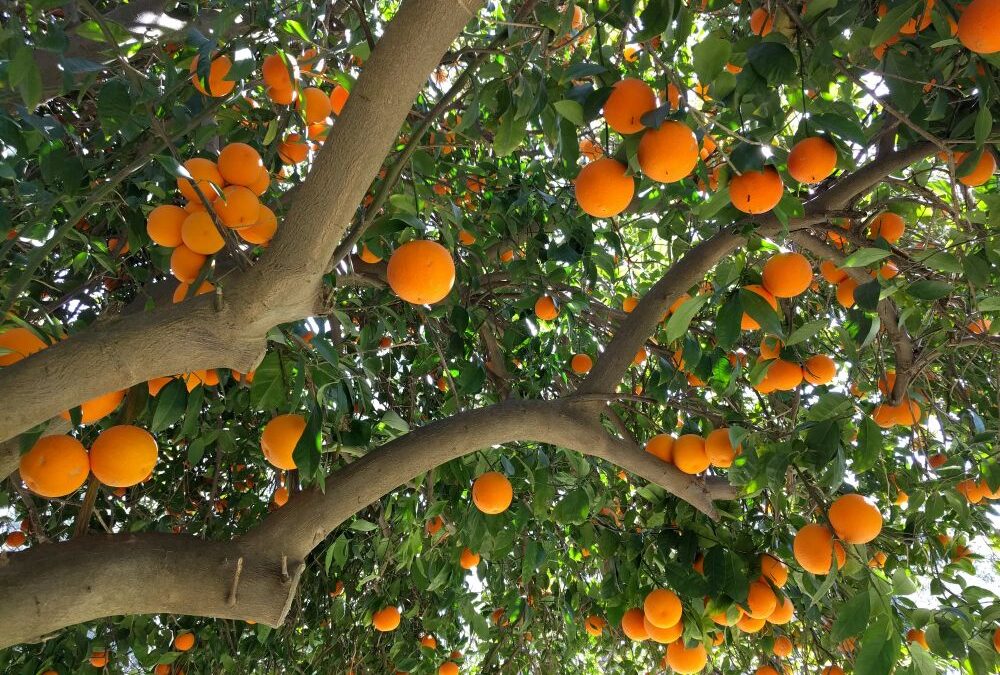
At the end of the day, I’m not worried about the Citrus Greening disease, also called HLB or Huanglongbing, because it fails the eyeball test. Where are all the dying trees? I don’t see them.
What is this HLB/Citrus Greening disease?
It’s a condition where, I’m told, a citrus tree has leaves that are mottled yellow and green, the fruit are misshapen and partly green and sour, and the vascular system of the tree (where the sap flows, like the tree’s blood vessels) are clogged. This HLB disease is said to be caused by a bacterium called Candidatus Liberibacter asiaticus (CLas for short) that is carried around from tree to tree by a tiny flying insect called an Asian citrus psyllid (ACP for short).
Walk with me down memory lane to look at a handful of pivotal experiences I’ve had over the years which inform my current perspective on the California citrus HLB story.
Back in February of 2012, I trained to be a Master Gardener volunteer in San Diego County. During my group’s class on “Issues in Plant Pathology,” the county’s plant pathologist opened her lecture with what she considered the most dangerous issue: Citrus HLB. I had never heard of it. In my notes, I wrote:.
“No cure; tree must be removed or serves as innoculum to infect other trees.”
My Master Gardener classmates and I were told that HLB was currently devastating citrus groves in Florida. Luckily, however, the deadly disease had not arrived in California yet. The ACP insect had been detected here since 2008, but the CLas bacteria had yet to be detected.
Only a couple weeks later, BOOM! We were informed that a tree in a backyard in Hacienda Heights in Los Angeles County had tested positive for HLB. This “poses a threat to all California citrus,” we were told.
Local news headlines were apocalyptic: “California braces for a deadly stalker of citrus.”
The California Department of Food and Agriculture descended upon the neighborhood and destroyed the lemon/pomelo tree that had the positive test, sprayed insecticides on all nearby citrus trees, and established a quarantine in the area in order to prevent the movement of citrus fruit or plant parts.
Through the next few years, my classmates and I were instructed to share informational handouts during speaking events and Master Gardener booths about the now-present disease of HLB. We were told to ask gardeners to inspect their trees for signs of this existential threat. The website that we were advised to direct gardeners to was CaliforniaCitrusThreat.org which stated, “HLB threatens to erase this tradition [of citrus trees] from our state’s history and put thousands out of work.”
In 2018, at the Festival of Fruit held by the California Rare Fruit Growers in Arcadia, I attended a presentation made by Tracy Kahn, Curator of the Citrus Variety Collection at U.C. Riverside, where she stated that 1,547 citrus trees in Southern California had tested positive for HLB at that point, and she recommended that if we wanted to save the citrus trees in our yards we should apply pesticides during each of their flushes of new growth in order to kill the insects that carried the CLas bacteria, and/or we could cover our trees with nets.
In Riverside, not far from the university, is the oldest Washington navel orange tree, and around this time it was covered with a protective net structure.
(My post, “Saving the Parent Washington navel orange tree.”)
California citrus seemed doomed.
But it had been six years since the first detection, and I was starting to secretly doubt the dire predictions. I had learned to spot the insect, ACP, and I had been seeing them all over the new flush on my trees for years. They were on everyone’s trees as far as I saw.
Much testing had been employed on trees throughout Southern California so increased detections occurred, as would be expected, but I wasn’t seeing sick trees.
So I chose not to follow Kahn’s advice about spraying or netting.
In 2022, during a presentation for citrus farmers in San Diego County, Neil McRoberts, Associate Professor of Plant Pathology at U.C. Davis, said, “I’m an epidemiologist . . . but personally, I’d be more worried about water than HLB if I were growing citrus in California.”
What? This was a new tone. This was the first change in tone regarding HLB that I’d heard from a U.C. researcher in ten years.
McRoberts went on to explain why he had become less worried about HLB. He had observed that both the CLas bacteria as well as the ACP insect find it harder to live in California than in Florida. McRoberts said that he could see after ten years of studying and testing that both were not proliferating here as they had in Florida, and he thought it was mainly due to climate. California’s colder winters and hotter summers slow down the reproduction of the insects and sometimes kill them.
After this event, I wrote the post, “Citrus, ants, and HLB: the latest research.”
I felt relief, but I also started to feel suspicion.
Thereafter, I began to do some homework. What are the foundations for the claims about this HLB disease, the CLas bacteria, and the ACP insects?
I contacted the most informed people I knew and asked for foundational papers to read. I was sent to “Huanglongbing: a destructive, newly emerging, century-old disease of citrus” by J.M. Bove from 2006 in the Journal of Plant Pathology. It contained no research of its own but was a comprehensive overview of the disease.
A couple of things stood out after reading it. One was that HLB is apparently a disease that was identified in China at least as far back as the 1870’s. In other words, it’s an old disease. But it took 150 years to cross the Pacific? So many people and so much plant material, including citrus plant material, have been coming to California (and the U.S. generally) from China since 1870 (the Meyer Lemon in 1908, for example). It’s hard to believe that this insect-bacterium-disease took so long to arrive.
My hunch became that the recent arrival was actually the HLB testing.
So how exactly is a citrus tree determined “HLB positive”? According to page 33 of the California Department of Food and Agriculture’s Action Plan for Asian Citrus Psyllid and Huanglongbing, “testing of plant samples for the presence of CLas [is done] using two USDA-validated multiplex TaqMan Real-time Polymerase Chain Reaction (qPCR) tests.”
The important thing to note is that even if you grant that these PCR tests are accurate, then all you are acknowledging is that they can detect whether DNA unique to the CLas bacteria is present within a tree. Only. PCR tests do not diagnose illness, sickness, disease.
The CLas bacterium is not the HLB disease. But maybe the presence of CLas within a tree means that it also has the HLB disease?
Now I wanted to back up further and ask this question: How do we know that the CLas bacteria causes the HLB disease? That’s what I’d always been told: The ACP insects carry the CLas bacteria inside their bodies and inject the bacteria into citrus trees when they feed on them, thereby infecting the citrus trees.
For example, on the U.C. pest management page for ACP and HLB disease it says, “[ACP] vectors the pathogen that causes huanglongbing disease (HLB).”
And on the CDFA page for HLB it says, “Huanglongbing (HLB) or citrus greening is caused by a phloem-restricted bacterium which is vectored by the Asian citrus psyllid (ACP). The scientific name of the bacterium is Candidatus Liberibacter asiaticus (CLas).”
But then I went to U.C. Riverside’s page on Huanglongbing and discovered totally different language. (U.C. Riverside is one of the premier citrus research universities in the world.) Its page never claims that HLB is caused by CLas. In fact, it states explicitly that “it is improper to refer to the HLB-associated bacterium [CLas] as the ‘causal agent’, the ‘agent’ or the ‘pathogen’ of HLB.” This is because “in spite of many attempts,” the necessary scientific criteria to claim that CLas causes the HLB disease have not been met. (Specifically, Koch’s postulates have not been met.) CLas can only be said to be “associated” with HLB.
The Bove paper from 2006 that I mentioned earlier admits the same: “Koch’s postulates could not be fulfilled. However . . . it is assumed that they are the causal agents of the diseases with which they are associated.”
So to be clear, authorities have been destroying citrus trees when they test positive for the presence of a bacterium that has not been shown to cause any disease.
Although the Bove paper didn’t contain any research of its own, it did help me find original research on HLB to read. I especially wanted to read about experiments that showed transmissibility of the disease. In other words, has HLB been shown to be passed from tree to tree in any way (whether or not through the ACP insects or CLas bacteria)?
I found that South Africans have studied this disease for many decades and performed numerous experiments aiming to figure out the cause. One 1965 paper by McClean and Oberholzer reported on and summarized many of these experiments.
The authors write: “Often [HLB disease] spreads destructively: this is the case in the orchard in Pretoria and in three small commercial areas. Sometimes it is present but fails to spread to new trees: this is the case in the orchard below the Hartebeespoort irrigation dam. Or it may be present in sectors of some trees where it remains confined without dangerous spread. So too with experiments in propagating from diseased trees. One bud or twig tip gives a healthy tree, the next a diseased one. For example, less than ten per cent of the progeny in one group of experiments developed greening; in a second series more than half the progeny were positive. And attempts to transmit the infection by grafts have been equally inconsistent. Many inoculations fail entirely, others succeed easily.”
In summary, they state: “[HLB] as a transmissible disease is full of contradictions.”
A few months ago, I called up a citrus farmer friend. By this time, it had become clear to me that HLB was not what I was told it was, or was going to become, in 2012. I didn’t know much about it, but I knew it wasn’t that. But this farmer manages large acreage and is involved in the highest levels of research discussion about HLB in California and maybe he knew secret stuff that I didn’t. Maybe he could put the worry back in me.
I asked him about many aspects of the citrus HLB situation, but none of his answers put the worry back in me, especially his answer to my last question.
“Have you personally seen, with your own eyes, a tree infected with HLB?” I asked him.
“No,” he said.

Thank you for your tedious research Mr. Alder.
Indeed, they would have us put a mask on our trees and plant them 6 feet apart.
Ditto ……..
wonder if that’s why CDFA went to evergreen nursery and destroyed thousands of citrus trees ?
Thank you Greg .
😄
Bingo!
100%!
Fascinating.
Thank you.
Fiona
Hi Greg, so what is the purpose of killing all of the so called infected trees. Who profits from this? Maybe I came up with my own answer! I had a chance to check out a few Shiranui Mandarin at Walter Anderson’s nursery here in San Diego and the employee had told me about the disease which he said all of our citrus trees will have to be destroyed within the next 5yrs. or so. At that time I thought who is going to come in my yard and kill my trees? Scary!
Just starting picking the Fuerte’s in San Diego downtown area. 3 weeks earlier than last year, thanks to our beautiful weather. 9out of 10 in taste and only will get better.
Thank You for your time and knowledge
Joe
Hi Greg,
Interesting post and hopefully we can avoid this on the west coast. We use, rather unsparingly ,NEEM oil on all of our fruit bearing and non fruit bearing trees. We fight scale on our olives, but the NEEM oil soak keeps it under control. Not sure if this method would be a good preventative solution for our citrus.
I learned a lot from the covid scam. The PCR test is easily manipulated to give a desired result by those who aim to make money at any cost to others. Now, I always follow the money to locate the truth. Greg, great research and excellent logic. My main problems are scale insects and leaf miners and of course, rats.
Also why we’ve netted so many of our fruits, fox squirrels and scrub jays being the worst offenders.
I got some mesh bags to put over the fruit but the rats just chew right through them and you can’t bag them all so they just eat the ones that aren’t bagged first. I have an early peach tree which serves as sacrificial fruit since it’s not very good anyway.
Greg- thank you for sharing. Your perspective certainly alleviates many of the concerns that I have harbored about my citrus trees.
Fascinating! Thank you, as always, for looking deeper.
Thank you for bringing sanity and thoughtful insight into the HLB issue. PCR tests have proven problematic in other scenarios. And, it seems to me, that if we have an endemic disease… We need to propagate the trees that have survived, not destroy them. We need to explore how to create healthier soil and trees that are strong enough to survive HLB and future stresses. I know nurseries and farmers that have been hit hard because they had to destroy all of their citrus trees based on a PCR test for a bacterium that may (or may not) indicate a tree has HLB.
So sad to see the state destroy 32,000 trees at Evergreen Nursery a few weeks ago without any attempted any other course of action.
Thanks so much Greg for your insight and research on this topic. Really appreciate the sanity aspect of it all, as it’s easy to believe what is presented in the media at first blush.
My big productive Valencia orange tree died last slowly last year in Gardena, however right next to it the Mandarin orange is beautiful. Our almost 100 year old Meyer lemon tree also is still doing great and 2 year old blood orange is just fine. I heard from my gardener that the orange trees of his other client in Rancho Palos Verdes died too. Thank you for your research! Very informative and interesting!
Great post Greg. Our society has gotten very reactive… it’s refreshing to be informed with less panic and more observation and research.
Thanks Greg. Appreciate your experience based approach. I too am a graduate of The University of My Eyes.
Also, enjoyed your book!
“Koch’s postulates are four foundational criteria established by German physician Robert Koch in 1882-1883 to prove a specific microbe causes a specific disease. They require identifying the pathogen in all diseased hosts, isolating it in pure culture, reproducing the disease in a healthy host, and re-isolating the same pathogen.
The Four Koch’s Postulates:
Association: The microbe must be present in all organisms suffering from the disease but absent from healthy ones.
Isolation: The microbe must be isolated from the diseased host and grown in pure culture.
Inoculation: The cultured microorganism must cause the disease when introduced into a healthy, susceptible organism.
Re-isolation: The microbe must be re-isolated from the newly infected host and identified as identical to the original agent.
Significance and Limitations:
Significance: These principles revolutionized microbiology, allowing Koch to identify the causative agents of tuberculosis, cholera, and anthrax, firmly establishing the germ theory of disease.
Limitations: They are not applicable to all pathogens, such as those that cannot be grown in pure culture (e.g., viruses, Mycobacterium leprae), asymptomatic carriers, or diseases caused by multiple organisms.
While still conceptually important, modern molecular techniques have updated these guidelines to include pathogen nucleic acid identification in tissues, known as molecular Koch’s postulates.” -Internet summary
It would appear that a mysterious “Florida factor” makes HLB much more serious there.
Thank you for this, Randy.
Many people agree about your mysterious “Florida factor” idea, and I’ve heard of different proposals as to what that factor is.
One that is commonly brought up is soil. Florida is notorious for its sandy and nutritionally deficient, and sometimes high pH, soil.
Importantly, symptoms of HLB disease have long been acknowledged to be very difficult if not impossible to distinguish from symptoms of other diseases as well as mineral deficiencies, especially zinc deficiency.
Because of this it makes sense that the CDFA does not determine that a tree has HLB based on symptoms. But more than that, look at what the Bove 2006 paper says about HLB symptoms:
“Specific HLB symptoms do not exist. Some symptoms, such as yellow shoots, leaf blotchy mottle, and lopsided fruits with color inversion and aborted seeds, are characteristic, but they do not always occur together on the same tree, they can be distorted or masked by symptoms of other diseases, or induced by causes other than HLB.”
No specific symptoms, but a specific disease?
Regarding Koch’s postulates, some scientists play a game of moving the goal posts when they can’t fulfill the postulates. They say the postulates need to be revised or updated in this modern age or because of our new technologies. But to me this appears like an attempt to avoid logic and prop up a prejudice.
Greg, we saw the goal Post being moved to call the covid jab a vaccine which was not a vaccine using the accepted definition so they changed the definition of vaccine.
Greg,
As a fellow UC Master Gardener we have been pummeled with HBL information. I have personally touted the dangers at our OC Fair information booth based upon UC ANR pamphlets and other handouts.
I live in a quarantine zone and have 14 mature citrus trees; thus I was initially concerned.
You have confirmed what I have been experiencing. Not scientific but experienced. I have not seen nor heard of an actual HBL case within Orange County. Plant material testing positive for CLas bacterium, yes, HBL, no.
I hope that your work here is the genesis for discussion amongst regulators and academics.
Thank you.
Don
Thank you, Greg. I have my first and only Murcott tangerine tree in its second year, and was dreading the warnings over “citrus blight”. It has yet to fruit, but 30% of the new leaves are indeed misshapen. I spray with a neem dilution, even fermented yogurt, and remove any diseased leaves by hand. There’s plenty of new growth after last month’s rain. I’ll only know if it’s a diseased tree if the fruit tastes bad, I suppose.
I appreciate your detailed research and sharing here.
This is really interesting!
Awhile back some government body knocked on my door several times to tell me they were looking for it. It got to the point where it was annoying, and I asked what they were going to do if they found it. I was told it WILL kill the tree, and we will destroy the tree [without asking permission] if we find it. I asked if I had the option to opt out, since they had never found anything and my tree is super healthy looking and wildly productive. They said yes, I could decline the whole inspection process. I also think they were only going to houses with citrus visible out front, which seemed like a really bad way to contain a terrible, infectious disease, lol.
Thanks for the excellent article. The pest that has killed my mandarin orange tree and is hurting my lemon, lime, and valencia orange trees here in coastal Encinitas, is the Glover scale insect. An untreated infestation gets on the leaves, branches, and fruit. I am using oil spray to control it, and painting the trunks of the trees. Fingers crossed!!
Greg, thanks for your perspective on this potentially serious problem. I wasn’t aware of it. I have had a similar problem when trying to raise fall color trees such as ginkgo and sweet gum. Both plants appear to have contracted verticillium wilt. Now that I’m trying to raise avocados, I’m wondering if you have seen verticillium infect avocado trees?
Hi Tom,
It was nice to meet you at the conference, by the way. One time I had a young Sharwil avocado tree die suddenly with symptoms that I’ve heard described as verticillium wilt: the leaves all turned brown and did not drop, and the tree died. What was the actual cause? I don’t know.
What’s most curious and interesting to me is that this tree was planted between (about five feet from) two other avocado trees. The wilt and death of the young Sharwil happened seven years ago, but to this day, the surrounding avocado trees have grown perfectly.
Greg, thanks for your reply. My ornamental trees languished in a more classical fashion over several years… losing a few branches each year, usually along one side of the tree along with the central crown. Similar to what you noted, one of three sweet gum has not been affected.
As an aside, I just finished your Mountain School documentary. I found it to be an enjoyable and informative work which also reveals a lot about you and your personal attributes. It reminds me of one of my sons, an ER physician in N.Carolina, who has always been fascinated with snakes and reptiles and helped develop a clinic in remote Guinea for treatment of venomous bites.
Thanks for speaking up about it, Greg. HLB has been quite the bogeyman. I’ve been afraid of it, but have had doubts. I hope someday we can trade citrus scions again with our friends. The CCPP is great, albeit crazy expensive.
I would like to hear UC’s response to your comments. This sounds a lot like antivax rhetoric. One, or a few people’s observations, do not make scientific consensus. The problem with this is, if your local observations are wrong (and let’s be honest, you and your friend’s perspectives and slanted toward maintaining your existing trees), you are spreading misinformation. I understand the angst of losing trees that are decades old, but what is the supposed financial incentive of the State in removing privately owned trees?
You rip Greg!🏄♂️ as a professional arborist here in San Diego this info helps. A customer asked me about this on Monday and I shared your findings with her.
Thanks, Joe! Glad it can be useful.
Greg, you continue to be an important reference for your dedicated research on these fruit tree concerns. I will be sharing with my clients. Greatly appreciate your posts!
Hi Greg,
I enjoy reading your posts, but find this one to be under informed, anti-scientific, and potentially misleading to your readers. There are 1,378 articles in PubMed, the publicly accessible database maintained by the US National Library of Medicine, on the topic of Huanglongbing and citrus. There you will find a wealth of information on the research on this disease, potential interactions that may modulate it and efforts to control it. Infection control, whether in humans or plants, requires mass interventions in order to safeguard the future—even in the setting where infection numbers are presently low, and often before full understanding of a pathogen exists.
Hi Allison,
Thanks for your comment and your kind words. I have a sincere request: Could you please be specific and quote an “under informed, anti-scientific, and potentially misleading” thing I wrote? Just choose the one that is the worst or most obvious. This way I can learn.
I picked my first CARA CARA Navel today from a three year old tree that was almost dead two years ago. I witnessed Psyllids feeding on the spring flush last year here in south Orange county. The first fruit was fully ripe and tasting great hoping I can dodge the HLB bullet and keep this tree and the neighboring Shasta Gold tree for many years..
Hi Chris,
Good to hear that your Cara Cara is recovering. Cara Cara is a weaker grower compared to most other citrus, from what I’ve observed. But the fruit is so good! I wish I still had some on my little tree but they are long eaten.
By the way, my little San Juan Capistrano avocado tree is growing well and pushing out flowers — I did not expect the flowers.
My San Juan tree is flowering too. It’s about 3 ft tall now and flushing foliage and flowers. The mother tree had quite a bit of fruit this year so maybe it is fruitful after all.
A few comments Greg:
– Koch’s postulates can’t be fulfilled here because the bacteria is phloem-limited. This means that the bacteria has become dependent on its host for survival. It steals sugars from the tree instead of producing its own (it does the same thing in the gut of the ACP). This is why we have to use the term “causal-agent.” A basic literature search would have definitely led you to this info.
– The disease has been present in China for so long without utter devastation (they still must use IPM to keep it under control) because the pest is native to the area. So, there are natural predators to this pest to keep it under control. We have released some of those pests here on the west coast and this has greatly helped CA stay ahead of the disease! Read any of Dr. Mark Hoddle’s research about the impressive work he has done and is still doing in order to accomplish this.
– We know and very much understand “the Florida Factor” it is not a mystery that trees in Florida perform very differently than California. They flush year round, not just fall and spring like in California. This means that the ACP always has new flush to feed on and can constantly re-infect the tree. Good for us we can concentrate our pesticide spraying to just two crucial points. Again, this has greatly helped us stay ahead of the disease.
– It is also important to note that HLB was detected in Florida in 2005 and the collapse was not immediate. It took years for the disease to fully take hold. Thank goodness we have a model to follow, some ideas on what works and what doesn’t, and time to make a game plan here. You should be wary to discount the threat of HLB without recognizing that the work of countless scientists has helped keep the disease at bay.
– The fact that over 10 years since finding our first infected tree in the state, we are still pulling trees one at a time in residential yards to keep the disease at bay – instead of burning down infested groves by the acre all over the state – is an incredible feat! We need master gardeners like yourself to believe scientists and help spread information about the work they do, not misinformation to push even more people away from sound research.